<?xml version="1.0" encoding="UTF-8"?>
<articles xmlns="http://coastobs.eu" xmlns:xsi="http://www.w3.org/2001/XMLSchema-instance" xsi="http://coastobs.eu/products-and-services.xsi">
  <ourProducts>
    <main>
      <teaserId>9</teaserId>
      <teaserTypeId>7</teaserTypeId>
      <icon/>
      <image/>
      <copyright/>
      <uri/>
      <url/>
      <rank>21</rank>
      <created>
        <date>2022-01-31 13:40:37.000000</date>
        <timezone_type>3</timezone_type>
        <timezone>UTC</timezone>
      </created>
      <updated>
        <date>2022-03-07 18:21:40.000000</date>
        <timezone_type>3</timezone_type>
        <timezone>UTC</timezone>
      </updated>
      <uuid>fdd642c3-8292-11ec-9a4e-000c292f0389</uuid>
      <teaserTypeName>Welcome - Our Products</teaserTypeName>
      <alpha3>eng</alpha3>
      <title>Our Products &amp; Services</title>
      <subtitle>We provide a range of diverse water quality data that fits into the users’ own data management and information systems.</subtitle>
      <description><![CDATA[<p>CoastObs uses satellite remote sensing to monitor coastal water environments.&nbsp;</p>

<p>We offer users a platform with satellite-derived products relevant for routine water quality monitoring and coastal environment assessment, for aquaculture and marine engineering.&nbsp;</p>

<p>CoastObs products and services include algal blooms, chlorophyll-a concentration, turbidity, seagrass per cent coverage, phytoplankton size classes, harmful algae, sediment plumes, and water surface temperature as well as integration with predictive models for products such as shellfish growth potential.&nbsp;</p>
]]></description>
      <content>
        <teaserContent>
          <teaserId>9</teaserId>
          <alpha3>eng</alpha3>
          <title>Our Products &amp; Services</title>
          <subtitle>We provide a range of diverse water quality data that fits into the users’ own data management and information systems.</subtitle>
          <description><![CDATA[<p>CoastObs uses satellite remote sensing to monitor coastal water environments.&nbsp;</p>

<p>We offer users a platform with satellite-derived products relevant for routine water quality monitoring and coastal environment assessment, for aquaculture and marine engineering.&nbsp;</p>

<p>CoastObs products and services include algal blooms, chlorophyll-a concentration, turbidity, seagrass per cent coverage, phytoplankton size classes, harmful algae, sediment plumes, and water surface temperature as well as integration with predictive models for products such as shellfish growth potential.&nbsp;</p>
]]></description>
          <url/>
          <created/>
          <updated>
            <date>2022-01-31 13:39:56.000000</date>
            <timezone_type>3</timezone_type>
            <timezone>UTC</timezone>
          </updated>
        </teaserContent>
        <teaserContent>
          <teaserId>9</teaserId>
          <alpha3>hun</alpha3>
          <title/>
          <subtitle/>
          <description/>
          <url/>
          <created/>
          <updated>
            <date>2022-01-31 13:39:56.000000</date>
            <timezone_type>3</timezone_type>
            <timezone>UTC</timezone>
          </updated>
        </teaserContent>
      </content>
      <tags>
        <tagInMaster>
          <tagId>2</tagId>
          <masterUuid>fdd642c3-8292-11ec-9a4e-000c292f0389</masterUuid>
          <tableName/>
          <updated>
            <date>2022-01-31 13:40:37.000000</date>
            <timezone_type>3</timezone_type>
            <timezone>UTC</timezone>
          </updated>
          <alpha3>eng</alpha3>
          <label>Teaser Group - Main</label>
          <description>Main teaser for a group</description>
          <uri>/tag/teaser-group-main</uri>
          <category>Teaser Group</category>
          <categoryArchive/>
          <tagCategoryId>1</tagCategoryId>
        </tagInMaster>
      </tags>
    </main>
    <items>
      <teaser>
        <teaserId>10</teaserId>
        <teaserTypeId>7</teaserTypeId>
        <icon/>
        <image>welcome/welcome-icons-svg/1st_tier.svg</image>
        <copyright/>
        <uri>/products-and-services#basic</uri>
        <url/>
        <rank>22</rank>
        <created>
          <date>2022-01-31 13:41:17.000000</date>
          <timezone_type>3</timezone_type>
          <timezone>UTC</timezone>
        </created>
        <updated>
          <date>2022-03-07 18:21:40.000000</date>
          <timezone_type>3</timezone_type>
          <timezone>UTC</timezone>
        </updated>
        <uuid>15544f8e-8293-11ec-9a4e-000c292f0389</uuid>
        <teaserTypeName>Welcome - Our Products</teaserTypeName>
        <alpha3>eng</alpha3>
        <title>Basic</title>
        <subtitle>Common products used in water monitoring through remote sensing.</subtitle>
        <description><![CDATA[<ul>
	<li>Chlorophyll-A</li>
	<li>Total Suspended Matter,</li>
	<li>Turbidity</li>
	<li>Sea Surface Temperature</li>
	<li>Shoreline Mapping</li>
</ul>
]]></description>
        <content>
          <teaserContent>
            <teaserId>10</teaserId>
            <alpha3>eng</alpha3>
            <title>Basic</title>
            <subtitle>Common products used in water monitoring through remote sensing.</subtitle>
            <description><![CDATA[<ul>
	<li>Chlorophyll-A</li>
	<li>Total Suspended Matter,</li>
	<li>Turbidity</li>
	<li>Sea Surface Temperature</li>
	<li>Shoreline Mapping</li>
</ul>
]]></description>
            <url/>
            <created/>
            <updated>
              <date>2022-01-31 13:39:56.000000</date>
              <timezone_type>3</timezone_type>
              <timezone>UTC</timezone>
            </updated>
          </teaserContent>
          <teaserContent>
            <teaserId>10</teaserId>
            <alpha3>hun</alpha3>
            <title/>
            <subtitle/>
            <description/>
            <url/>
            <created/>
            <updated>
              <date>2022-01-31 13:39:56.000000</date>
              <timezone_type>3</timezone_type>
              <timezone>UTC</timezone>
            </updated>
          </teaserContent>
        </content>
        <tags/>
      </teaser>
      <teaser>
        <teaserId>11</teaserId>
        <teaserTypeId>7</teaserTypeId>
        <icon/>
        <image>welcome/welcome-icons-svg/2nd_tier.svg</image>
        <copyright/>
        <uri>/products-and-services#innovative</uri>
        <url/>
        <rank>23</rank>
        <created>
          <date>2022-01-31 13:41:57.000000</date>
          <timezone_type>3</timezone_type>
          <timezone>UTC</timezone>
        </created>
        <updated>
          <date>2022-03-07 18:21:40.000000</date>
          <timezone_type>3</timezone_type>
          <timezone>UTC</timezone>
        </updated>
        <uuid>2d8e1bff-8293-11ec-9a4e-000c292f0389</uuid>
        <teaserTypeName>Welcome - Our Products</teaserTypeName>
        <alpha3>eng</alpha3>
        <title>Innovative</title>
        <subtitle>New products highly relevant  to coastal zone management.</subtitle>
        <description><![CDATA[<ul>
	<li>Intertidal Seagrass Mapping</li>
	<li>Phytoplankton Primary Production</li>
	<li>Harmful Algal Blooms (Hab) Indicator</li>
	<li>Phytoplankton Size Classes (PSC)</li>
</ul>
]]></description>
        <content>
          <teaserContent>
            <teaserId>11</teaserId>
            <alpha3>eng</alpha3>
            <title>Innovative</title>
            <subtitle>New products highly relevant  to coastal zone management.</subtitle>
            <description><![CDATA[<ul>
	<li>Intertidal Seagrass Mapping</li>
	<li>Phytoplankton Primary Production</li>
	<li>Harmful Algal Blooms (Hab) Indicator</li>
	<li>Phytoplankton Size Classes (PSC)</li>
</ul>
]]></description>
            <url/>
            <created/>
            <updated>
              <date>2022-01-31 13:39:56.000000</date>
              <timezone_type>3</timezone_type>
              <timezone>UTC</timezone>
            </updated>
          </teaserContent>
          <teaserContent>
            <teaserId>11</teaserId>
            <alpha3>hun</alpha3>
            <title/>
            <subtitle/>
            <description/>
            <url/>
            <created/>
            <updated>
              <date>2022-01-31 13:39:56.000000</date>
              <timezone_type>3</timezone_type>
              <timezone>UTC</timezone>
            </updated>
          </teaserContent>
        </content>
        <tags/>
      </teaser>
      <teaser>
        <teaserId>12</teaserId>
        <teaserTypeId>7</teaserTypeId>
        <icon/>
        <image>welcome/welcome-icons-svg/3rd_tier.svg</image>
        <copyright/>
        <uri>/products-and-services#higher-level</uri>
        <url/>
        <rank>24</rank>
        <created>
          <date>2022-01-31 13:42:34.000000</date>
          <timezone_type>3</timezone_type>
          <timezone>UTC</timezone>
        </created>
        <updated>
          <date>2022-03-07 18:21:40.000000</date>
          <timezone_type>3</timezone_type>
          <timezone>UTC</timezone>
        </updated>
        <uuid>438440a0-8293-11ec-9a4e-000c292f0389</uuid>
        <teaserTypeName>Welcome - Our Products</teaserTypeName>
        <alpha3>eng</alpha3>
        <title>Higher level</title>
        <subtitle>Products that include a combination of spatial and temporal aggregation, classification and integration with additional data. </subtitle>
        <description><![CDATA[<ul>
	<li>Statistics/Aggregation</li>
	<li>Indicators For Water Framework Directive Reporting</li>
	<li>Harmful Algal Blooms Forecast</li>
	<li>Shellfish Culture Potential</li>
	<li>Phytoplankton Bloom Phenology</li>
	<li>Sediment Plume Morphology</li>
</ul>
]]></description>
        <content>
          <teaserContent>
            <teaserId>12</teaserId>
            <alpha3>eng</alpha3>
            <title>Higher level</title>
            <subtitle>Products that include a combination of spatial and temporal aggregation, classification and integration with additional data. </subtitle>
            <description><![CDATA[<ul>
	<li>Statistics/Aggregation</li>
	<li>Indicators For Water Framework Directive Reporting</li>
	<li>Harmful Algal Blooms Forecast</li>
	<li>Shellfish Culture Potential</li>
	<li>Phytoplankton Bloom Phenology</li>
	<li>Sediment Plume Morphology</li>
</ul>
]]></description>
            <url/>
            <created/>
            <updated>
              <date>2022-01-31 13:39:56.000000</date>
              <timezone_type>3</timezone_type>
              <timezone>UTC</timezone>
            </updated>
          </teaserContent>
          <teaserContent>
            <teaserId>12</teaserId>
            <alpha3>hun</alpha3>
            <title/>
            <subtitle/>
            <description/>
            <url/>
            <created/>
            <updated>
              <date>2022-01-31 13:39:56.000000</date>
              <timezone_type>3</timezone_type>
              <timezone>UTC</timezone>
            </updated>
          </teaserContent>
        </content>
        <tags/>
      </teaser>
      <teaser>
        <teaserId>13</teaserId>
        <teaserTypeId>7</teaserTypeId>
        <icon/>
        <image>welcome/welcome-icons-svg/4th_tier.svg</image>
        <copyright/>
        <uri>/products-and-services#water-quality-data</uri>
        <url/>
        <rank>25</rank>
        <created>
          <date>2022-01-31 13:43:08.000000</date>
          <timezone_type>3</timezone_type>
          <timezone>UTC</timezone>
        </created>
        <updated>
          <date>2022-03-07 18:21:40.000000</date>
          <timezone_type>3</timezone_type>
          <timezone>UTC</timezone>
        </updated>
        <uuid>57b6a7ab-8293-11ec-9a4e-000c292f0389</uuid>
        <teaserTypeName>Welcome - Our Products</teaserTypeName>
        <alpha3>eng</alpha3>
        <title>Water-quality data</title>
        <subtitle>Product in-situ validation, analysis and reporting. </subtitle>
        <description><![CDATA[<ul>
	<li>In Situ Data For Eo Validation</li>
	<li>Near Real Time Services</li>
	<li>One Off Analysis</li>
	<li>Periodic Reporting Services</li>
</ul>
]]></description>
        <content>
          <teaserContent>
            <teaserId>13</teaserId>
            <alpha3>eng</alpha3>
            <title>Water-quality data</title>
            <subtitle>Product in-situ validation, analysis and reporting. </subtitle>
            <description><![CDATA[<ul>
	<li>In Situ Data For Eo Validation</li>
	<li>Near Real Time Services</li>
	<li>One Off Analysis</li>
	<li>Periodic Reporting Services</li>
</ul>
]]></description>
            <url/>
            <created/>
            <updated>
              <date>2022-01-31 13:39:56.000000</date>
              <timezone_type>3</timezone_type>
              <timezone>UTC</timezone>
            </updated>
          </teaserContent>
          <teaserContent>
            <teaserId>13</teaserId>
            <alpha3>hun</alpha3>
            <title/>
            <subtitle/>
            <description/>
            <url/>
            <created/>
            <updated>
              <date>2022-01-31 13:39:56.000000</date>
              <timezone_type>3</timezone_type>
              <timezone>UTC</timezone>
            </updated>
          </teaserContent>
        </content>
        <tags/>
      </teaser>
    </items>
  </ourProducts>
  <basic>
    <article>
      <articleId>13</articleId>
      <author/>
      <publishingDate>
        <date>2022-01-31 13:18:40.000000</date>
        <timezone_type>3</timezone_type>
        <timezone>UTC</timezone>
      </publishingDate>
      <status>published</status>
      <coverImage/>
      <largeThumbnail>articles/basic-icons/5_B_Chlorophyll1.png</largeThumbnail>
      <thumbnail>articles/basic-icons/5_B_Chlorophyll12.png</thumbnail>
      <articleCategoryId>4</articleCategoryId>
      <uuid>49ced25d-8290-11ec-9a4e-000c292f0389</uuid>
      <updated>
        <date>2022-01-31 13:21:16.000000</date>
        <timezone_type>3</timezone_type>
        <timezone>UTC</timezone>
      </updated>
      <alpha3>eng</alpha3>
      <label/>
      <slug>chlorophyll-a</slug>
      <title>Chlorophyll-A</title>
      <subtitle/>
      <summary/>
      <lead>CoastObs uses Earth Observation and in situ data to provide an overview of chlorophyll-a (Chl-a); a pigment found in plants and algae that allows them to convert sunlight into usable energy.</lead>
      <content><![CDATA[<h2>Why is it important?</h2>

<p>Since it is the essential pigment in phytoplankton, it can be used as a proxy for algal biomass, and as phytoplankton constitutes the base of aquatic food web, Chl-a concentration can tell us food availability, something important for example, for shellfish farmers. Furthermore, in coastal waters, phytoplankton biomass serves as an important water quality parameter since the abundance of algae can potentially indicate the degree of eutrophication in a specific water body or be related to the occurrence of Harmful Algae Blooms (HABs).</p>

<h2>What does CoastObs offer?</h2>

<p>CoastObs service provides highly accurate and timely geospatial information of Chl-a concentration at a spatial/temporal resolution of 300m (daily) or 10m (5 days).</p>

<h2>How was the data validated?</h2>

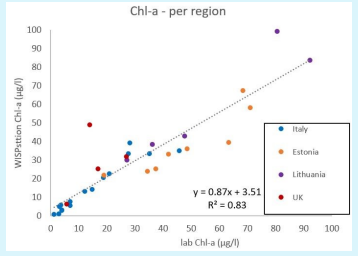
<p>Satellite-retrieved Chl-a concentrations were validated against ground data collected close in time to the satellite overpass. The Chl-a samples collected by UVIGO, CNR, USTIR and HZ were analysed at University of Stirling using High Performance Liquid Chromatography (HPLC).</p>

<div class="light-blue">
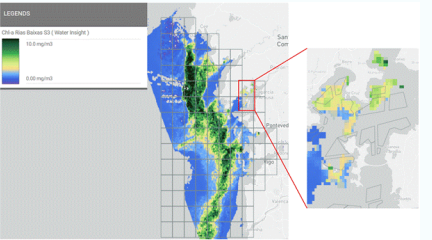
<h3 class="text-center">Case study example: Chlorophyl-a maps in the Galician area.&nbsp;</h3>
<img alt="" src="/assets/content/articles/coastobs_casestudy_chloro.PNG" style="float:left; height:233px; width:550px" />
<p>Figure 1. The map shows a scale of the chlorophyll-a present in the Galician Rias Baixas waters going from a scale of 1 mg/m3 in blue to 50 mg/m3 in green. A co-ordinate raster is shown, and after zooming in raft polygons (aquaculture areas) are shown</p>
</div>


<h2>Limitations</h2>

<ul>
	<li>Availability depends on cloud cover</li>
	<li>Quality of retrieval depends on sensor characteristics, can be impacted by high suspended sediment or CDOM concentrations.</li>
	<li>In shallow waters, bottom visibility can interfere with the signal.</li>
</ul>

<h2>Area Covered</h2>

<p>We can cover any coastal area you may need.</p>
]]></content>
      <category>Basic service</category>
      <metaTitle>Chlorophyll-A</metaTitle>
      <metaDescription/>
      <uri>/articles/13/chlorophyll-a</uri>
      <articleContent>
        <articleContent>
          <articleId>13</articleId>
          <alpha3>eng</alpha3>
          <label/>
          <slug>chlorophyll-a</slug>
          <title>Chlorophyll-A</title>
          <subtitle/>
          <summary/>
          <lead>CoastObs uses Earth Observation and in situ data to provide an overview of chlorophyll-a (Chl-a); a pigment found in plants and algae that allows them to convert sunlight into usable energy.</lead>
          <content><![CDATA[<h2>Why is it important?</h2>

<p>Since it is the essential pigment in phytoplankton, it can be used as a proxy for algal biomass, and as phytoplankton constitutes the base of aquatic food web, Chl-a concentration can tell us food availability, something important for example, for shellfish farmers. Furthermore, in coastal waters, phytoplankton biomass serves as an important water quality parameter since the abundance of algae can potentially indicate the degree of eutrophication in a specific water body or be related to the occurrence of Harmful Algae Blooms (HABs).</p>

<h2>What does CoastObs offer?</h2>

<p>CoastObs service provides highly accurate and timely geospatial information of Chl-a concentration at a spatial/temporal resolution of 300m (daily) or 10m (5 days).</p>

<h2>How was the data validated?</h2>

<p>Satellite-retrieved Chl-a concentrations were validated against ground data collected close in time to the satellite overpass. The Chl-a samples collected by UVIGO, CNR, USTIR and HZ were analysed at University of Stirling using High Performance Liquid Chromatography (HPLC).</p>

<div class="light-blue">
<h3 class="text-center">Case study example: Chlorophyl-a maps in the Galician area.&nbsp;</h3>
<img alt="" src="/assets/content/articles/coastobs_casestudy_chloro.PNG" style="float:left; height:233px; width:550px" />
<p>Figure 1. The map shows a scale of the chlorophyll-a present in the Galician Rias Baixas waters going from a scale of 1 mg/m3 in blue to 50 mg/m3 in green. A co-ordinate raster is shown, and after zooming in raft polygons (aquaculture areas) are shown</p>
</div>


<h2>Limitations</h2>

<ul>
	<li>Availability depends on cloud cover</li>
	<li>Quality of retrieval depends on sensor characteristics, can be impacted by high suspended sediment or CDOM concentrations.</li>
	<li>In shallow waters, bottom visibility can interfere with the signal.</li>
</ul>

<h2>Area Covered</h2>

<p>We can cover any coastal area you may need.</p>
]]></content>
          <metaTitle/>
          <metaDescription/>
          <updated>
            <date>2022-01-31 13:21:16.000000</date>
            <timezone_type>3</timezone_type>
            <timezone>UTC</timezone>
          </updated>
        </articleContent>
        <articleContent>
          <articleId>13</articleId>
          <alpha3>hun</alpha3>
          <label/>
          <slug/>
          <title/>
          <subtitle/>
          <summary/>
          <lead/>
          <content/>
          <metaTitle/>
          <metaDescription/>
          <updated>
            <date>2022-01-31 13:21:16.000000</date>
            <timezone_type>3</timezone_type>
            <timezone>UTC</timezone>
          </updated>
        </articleContent>
      </articleContent>
    </article>
    <article>
      <articleId>14</articleId>
      <author/>
      <publishingDate>
        <date>2022-01-31 13:18:40.000000</date>
        <timezone_type>3</timezone_type>
        <timezone>UTC</timezone>
      </publishingDate>
      <status>published</status>
      <coverImage/>
      <largeThumbnail>articles/Thumbnails/6_B_TSM.png</largeThumbnail>
      <thumbnail>articles/Thumbnails/6_B_TSM.png</thumbnail>
      <articleCategoryId>4</articleCategoryId>
      <uuid>622c0a32-8290-11ec-9a4e-000c292f0389</uuid>
      <updated>
        <date>2022-01-31 13:21:57.000000</date>
        <timezone_type>3</timezone_type>
        <timezone>UTC</timezone>
      </updated>
      <alpha3>eng</alpha3>
      <label/>
      <slug>total-suspended-matter</slug>
      <title>Total Suspended Matter</title>
      <subtitle/>
      <summary/>
      <lead>CoastObs uses Earth Observation and in situ data to provide information on TSM at a regular frequency.</lead>
      <content><![CDATA[<h2>Why is it important?</h2>

<p>TSM plays an important role in water quality management since it determines the light climate in the water. TSM can give us an insight into coastal dynamics (erosion, accretion) and total primary production. TSM can further provide information on anthropogenic impacts, such as dredging and fluxes of heavy metals and micropollutants.</p>

<h2>What does CoastObs offer?</h2>

<p>CoastObs service provides highly accurate and timely geospatial information for providing total suspended matter maps at a spatial/temporal resolution of 300m (daily), 10m (5 days), or higher resolution (variable).</p>

<h2>How was the data validated?</h2>

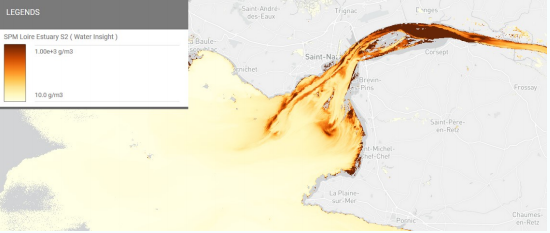
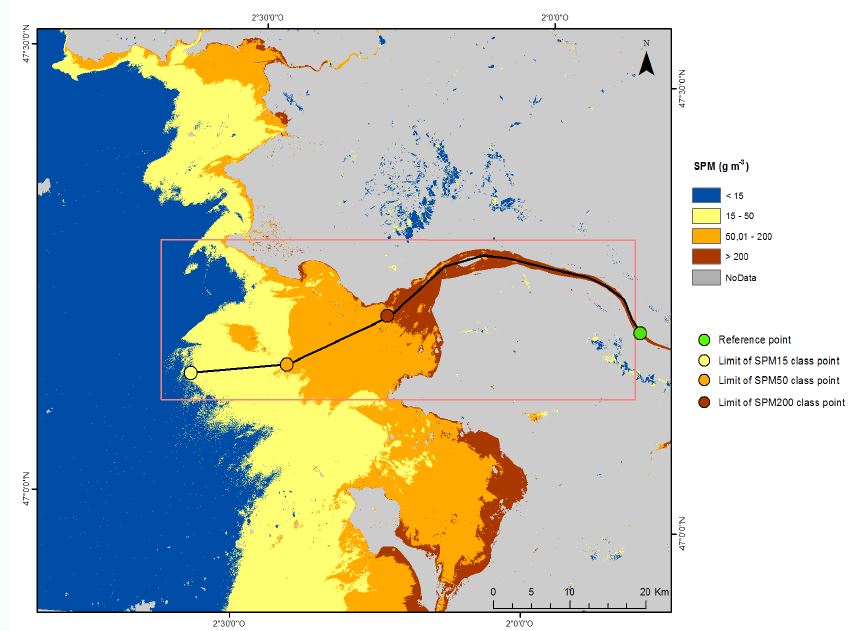
<p>The TSM product was validated using one year of high-frequency measurement in the Loire estuary (Figure 1) over a large range of TSM concentration (10 – 3000 g m-3 ). The in situ TSM data was provided by a regional structure in charge of the estuary’s environmental monitoring (http://www.loire-estuaire.org/accueil).</p>

<div class="light-blue">
<h3 class="text-center">Case study example: Suspended matter in in the Loire estuary</h3>
<img alt="" src="/assets/content/TSM-service.PNG" style="float:left; height:233px; width:550px" />
<p>Figure 1. TSM map in the Loire Estuary, France, derived from Sentinel2 data, showing a turbid sediment plume flowing into the ocean.</p>
</div>

<h2>Limitations</h2>

<ul>
	<li>Regional variability of sediment characteristics may require algorithm calibration</li>
	<li>In shallow waters, bottom visibility can interfere with the signal</li>
	<li>Availability depends on cloud cover</li>
</ul>
]]></content>
      <category>Basic service</category>
      <metaTitle>Total Suspended Matter</metaTitle>
      <metaDescription/>
      <uri>/articles/14/total-suspended-matter</uri>
      <articleContent>
        <articleContent>
          <articleId>14</articleId>
          <alpha3>eng</alpha3>
          <label/>
          <slug>total-suspended-matter</slug>
          <title>Total Suspended Matter</title>
          <subtitle/>
          <summary/>
          <lead>CoastObs uses Earth Observation and in situ data to provide information on TSM at a regular frequency.</lead>
          <content><![CDATA[<h2>Why is it important?</h2>

<p>TSM plays an important role in water quality management since it determines the light climate in the water. TSM can give us an insight into coastal dynamics (erosion, accretion) and total primary production. TSM can further provide information on anthropogenic impacts, such as dredging and fluxes of heavy metals and micropollutants.</p>

<h2>What does CoastObs offer?</h2>

<p>CoastObs service provides highly accurate and timely geospatial information for providing total suspended matter maps at a spatial/temporal resolution of 300m (daily), 10m (5 days), or higher resolution (variable).</p>

<h2>How was the data validated?</h2>

<p>The TSM product was validated using one year of high-frequency measurement in the Loire estuary (Figure 1) over a large range of TSM concentration (10 – 3000 g m-3 ). The in situ TSM data was provided by a regional structure in charge of the estuary’s environmental monitoring (http://www.loire-estuaire.org/accueil).</p>

<div class="light-blue">
<h3 class="text-center">Case study example: Suspended matter in in the Loire estuary</h3>
<img alt="" src="/assets/content/TSM-service.PNG" style="float:left; height:233px; width:550px" />
<p>Figure 1. TSM map in the Loire Estuary, France, derived from Sentinel2 data, showing a turbid sediment plume flowing into the ocean.</p>
</div>

<h2>Limitations</h2>

<ul>
	<li>Regional variability of sediment characteristics may require algorithm calibration</li>
	<li>In shallow waters, bottom visibility can interfere with the signal</li>
	<li>Availability depends on cloud cover</li>
</ul>
]]></content>
          <metaTitle/>
          <metaDescription/>
          <updated>
            <date>2022-01-31 13:21:57.000000</date>
            <timezone_type>3</timezone_type>
            <timezone>UTC</timezone>
          </updated>
        </articleContent>
        <articleContent>
          <articleId>14</articleId>
          <alpha3>hun</alpha3>
          <label/>
          <slug/>
          <title/>
          <subtitle/>
          <summary/>
          <lead/>
          <content/>
          <metaTitle/>
          <metaDescription/>
          <updated>
            <date>2022-01-31 13:21:57.000000</date>
            <timezone_type>3</timezone_type>
            <timezone>UTC</timezone>
          </updated>
        </articleContent>
      </articleContent>
    </article>
    <article>
      <articleId>19</articleId>
      <author/>
      <publishingDate>
        <date>2022-02-08 15:59:38.000000</date>
        <timezone_type>3</timezone_type>
        <timezone>UTC</timezone>
      </publishingDate>
      <status>published</status>
      <coverImage/>
      <largeThumbnail>articles/Thumbnails/7_B_TUR.png</largeThumbnail>
      <thumbnail>articles/Thumbnails/7_B_TUR.png</thumbnail>
      <articleCategoryId>4</articleCategoryId>
      <uuid>7547eb51-88fc-11ec-9a4e-000c292f0389</uuid>
      <updated>
        <date>2022-02-08 17:30:42.000000</date>
        <timezone_type>3</timezone_type>
        <timezone>UTC</timezone>
      </updated>
      <alpha3>eng</alpha3>
      <label/>
      <slug>turbidity</slug>
      <title>Turbidity</title>
      <subtitle/>
      <summary/>
      <lead>CoastObs uses Earth Observation and in situ data to provide an overview of turbidity, an optical determination of water clarity.</lead>
      <content><![CDATA[<h2>Why is it important?</h2>

<p>Turbidity tells us the clarity of water, or how transparent water is. Clarity is determined by the depth that sunlight penetrates in water. The further sunlight can reach, the higher the water clarity. The clearer the water, the deeper the photic zone and the greater the potential for photosynthetic production. Turbidity, together with measurements of total suspended matter and coloured dissolved organic material, are often used to characterize the quality of water. A sudden increase in turbidity in a previously clear body of water is a cause for concern.</p>

<h2>What does CoastObs offer?</h2>

<p>CoastObs service provides highly accurate and timely geospatial information for providing turbidity maps at a spatial/temporal resolution of10m (5 days), or high resolution (variable).</p>

<h2>How was the data validated?</h2>

<p>To assess the accuracy of turbidity products derived from S2 imagery, in situ data measured close in time to the satellite overpass was used. In situ data included turbidity profiles measured during field activities and continuous real-time data from turbidity sensors at fixed locations.</p>

<div class="light-blue">
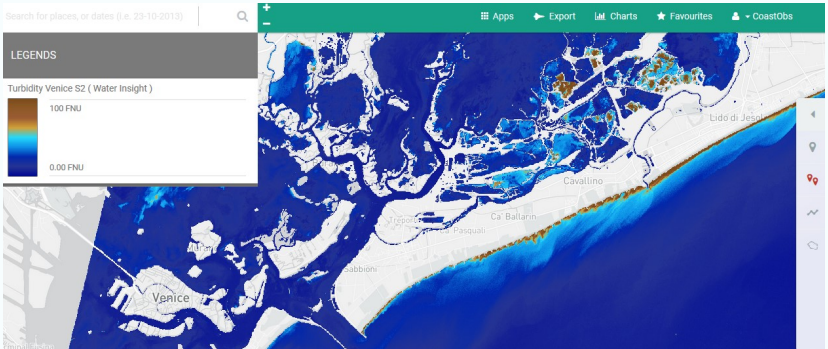
<h3 class="text-center">Case study example: Turbidity map in the Venice Lagoon.</h3>
<img alt="" src="/assets/content/articles/BasicServices/turbidity-venice.PNG" style="float:left; height:349px; width:828px" />
<p>Figure 6 is taken from CoastObs platform and shows the turbidity in the Venice Lagoon, Italy. Turbidity maps can be found in many more regions as part of our products available.</p>
</div>
]]></content>
      <category>Basic service</category>
      <metaTitle>Turbidity</metaTitle>
      <metaDescription/>
      <uri>/articles/19/turbidity</uri>
      <articleContent>
        <articleContent>
          <articleId>19</articleId>
          <alpha3>eng</alpha3>
          <label/>
          <slug>turbidity</slug>
          <title>Turbidity</title>
          <subtitle/>
          <summary/>
          <lead>CoastObs uses Earth Observation and in situ data to provide an overview of turbidity, an optical determination of water clarity.</lead>
          <content><![CDATA[<h2>Why is it important?</h2>

<p>Turbidity tells us the clarity of water, or how transparent water is. Clarity is determined by the depth that sunlight penetrates in water. The further sunlight can reach, the higher the water clarity. The clearer the water, the deeper the photic zone and the greater the potential for photosynthetic production. Turbidity, together with measurements of total suspended matter and coloured dissolved organic material, are often used to characterize the quality of water. A sudden increase in turbidity in a previously clear body of water is a cause for concern.</p>

<h2>What does CoastObs offer?</h2>

<p>CoastObs service provides highly accurate and timely geospatial information for providing turbidity maps at a spatial/temporal resolution of10m (5 days), or high resolution (variable).</p>

<h2>How was the data validated?</h2>

<p>To assess the accuracy of turbidity products derived from S2 imagery, in situ data measured close in time to the satellite overpass was used. In situ data included turbidity profiles measured during field activities and continuous real-time data from turbidity sensors at fixed locations.</p>

<div class="light-blue">
<h3 class="text-center">Case study example: Turbidity map in the Venice Lagoon.</h3>
<img alt="" src="/assets/content/articles/BasicServices/turbidity-venice.PNG" style="float:left; height:349px; width:828px" />
<p>Figure 6 is taken from CoastObs platform and shows the turbidity in the Venice Lagoon, Italy. Turbidity maps can be found in many more regions as part of our products available.</p>
</div>
]]></content>
          <metaTitle/>
          <metaDescription/>
          <updated>
            <date>2022-02-08 17:30:42.000000</date>
            <timezone_type>3</timezone_type>
            <timezone>UTC</timezone>
          </updated>
        </articleContent>
        <articleContent>
          <articleId>19</articleId>
          <alpha3>hun</alpha3>
          <label/>
          <slug/>
          <title/>
          <subtitle/>
          <summary/>
          <lead/>
          <content/>
          <metaTitle/>
          <metaDescription/>
          <updated>
            <date>2022-02-08 17:30:42.000000</date>
            <timezone_type>3</timezone_type>
            <timezone>UTC</timezone>
          </updated>
        </articleContent>
      </articleContent>
    </article>
    <article>
      <articleId>20</articleId>
      <author/>
      <publishingDate>
        <date>2022-02-14 12:09:01.000000</date>
        <timezone_type>3</timezone_type>
        <timezone>UTC</timezone>
      </publishingDate>
      <status>published</status>
      <coverImage>articles/Thumbnails/8_B_SST.png</coverImage>
      <largeThumbnail>articles/Thumbnails/8_B_SST.png</largeThumbnail>
      <thumbnail>articles/Thumbnails/8_B_SST.png</thumbnail>
      <articleCategoryId>4</articleCategoryId>
      <uuid>47ed35b2-8d88-11ec-9a4e-000c292f0389</uuid>
      <updated>
        <date>2022-02-14 12:21:40.000000</date>
        <timezone_type>3</timezone_type>
        <timezone>UTC</timezone>
      </updated>
      <alpha3>eng</alpha3>
      <label/>
      <slug>sea-surface-temperature-sst</slug>
      <title>SEA SURFACE TEMPERATURE (SST)</title>
      <subtitle/>
      <summary><![CDATA[<h2>Why is it important?</h2>

<p>Sea surface temperature provides fundamental information on the global climate system. SST is an essential parameter in weather forecasting and atmospheric model simulations and is also important for the study of marine ecosystems. SST measurements benefit a wide spectrum of operational applications, including climate and seasonal monitoring/forecasting, military defence operations, validation of atmospheric models, sea turtle tracking, evaluation of coral bleaching, tourism, and commercial fisheries management.</p>

<h2>What does CoastObs offer?</h2>

<p>CoastObs service provides highly accurate and timely geospatial information for SST maps at a spatial/temporal resolution of 1 km (gap-filled, daily), 300m (daily) or 100m (16 days).</p>

<h2>How was the data validated?</h2>

<p>SST data is validated by many researchers around the world. Within CoastObs, the 1km gap filled GHRSST data was validated against public in situ data of the Dutch national monitoring agency Rijkswaterstaat, for a location in the Ems estuary in the Wadden Sea.</p>

<div class="light-blue">
<h3 class="text-center">Case study example: SST map in the coast of Galicia, Spain.</h3>

<p>Figure 1. SST map and time series of a selected point in the Galician coastal area.</p>
</div>

<h2>Limitations</h2>

<p>The 300 m and 100 m are available depending on cloud cover, like most of the products. The 1 km data is gap filled by a model and therefore always available.</p>
]]></summary>
      <lead>CoastObs uses Earth Observation and in situ data to provide an overview of sea surface temperature at extensive regions.</lead>
      <content><![CDATA[<h2>Why is it important?</h2>

<p>Sea surface temperature provides fundamental information on the global climate system. SST is an essential parameter in weather forecasting and atmospheric model simulations and is also important for the study of marine ecosystems. SST measurements benefit a wide spectrum of operational applications, including climate and seasonal monitoring/forecasting, military defence operations, validation of atmospheric models, sea turtle tracking, evaluation of coral bleaching, tourism, and commercial fisheries management.</p>

<h2>What does CoastObs offer?</h2>

<p>CoastObs service provides highly accurate and timely geospatial information for SST maps at a spatial/temporal resolution of 1 km (gap-filled, daily), 300m (daily) or 100m (16 days).</p>

<h2>How was the data validated?</h2>

<p>SST data is validated by many researchers around the world. Within CoastObs, the 1km gap filled GHRSST data was validated against public in situ data of the Dutch national monitoring agency Rijkswaterstaat, for a location in the Ems estuary in the Wadden Sea.</p>

<div class="light-blue">
<h3 class="text-center">Case study example: SST map in the coast of Galicia, Spain.</h3>
<img alt="" src="/assets/content/SST_Galicia.PNG" style="float:left; height:349px; width:828px" />
<p>Figure 1. SST map and time series of a selected point in the Galician coastal area.</p>
</div>


<h2>Limitations</h2>
The 300 m and 100 m are available depending on cloud cover, like most of the products. The 1 km data is gap filled by a model and therefore always available.]]></content>
      <category>Basic service</category>
      <metaTitle>SEA SURFACE TEMPERATURE (SST)</metaTitle>
      <metaDescription/>
      <uri>/articles/20/sea-surface-temperature-sst</uri>
      <articleContent>
        <articleContent>
          <articleId>20</articleId>
          <alpha3>eng</alpha3>
          <label/>
          <slug>sea-surface-temperature-sst</slug>
          <title>SEA SURFACE TEMPERATURE (SST)</title>
          <subtitle/>
          <summary><![CDATA[<h2>Why is it important?</h2>

<p>Sea surface temperature provides fundamental information on the global climate system. SST is an essential parameter in weather forecasting and atmospheric model simulations and is also important for the study of marine ecosystems. SST measurements benefit a wide spectrum of operational applications, including climate and seasonal monitoring/forecasting, military defence operations, validation of atmospheric models, sea turtle tracking, evaluation of coral bleaching, tourism, and commercial fisheries management.</p>

<h2>What does CoastObs offer?</h2>

<p>CoastObs service provides highly accurate and timely geospatial information for SST maps at a spatial/temporal resolution of 1 km (gap-filled, daily), 300m (daily) or 100m (16 days).</p>

<h2>How was the data validated?</h2>

<p>SST data is validated by many researchers around the world. Within CoastObs, the 1km gap filled GHRSST data was validated against public in situ data of the Dutch national monitoring agency Rijkswaterstaat, for a location in the Ems estuary in the Wadden Sea.</p>

<div class="light-blue">
<h3 class="text-center">Case study example: SST map in the coast of Galicia, Spain.</h3>

<p>Figure 1. SST map and time series of a selected point in the Galician coastal area.</p>
</div>

<h2>Limitations</h2>

<p>The 300 m and 100 m are available depending on cloud cover, like most of the products. The 1 km data is gap filled by a model and therefore always available.</p>
]]></summary>
          <lead>CoastObs uses Earth Observation and in situ data to provide an overview of sea surface temperature at extensive regions.</lead>
          <content><![CDATA[<h2>Why is it important?</h2>

<p>Sea surface temperature provides fundamental information on the global climate system. SST is an essential parameter in weather forecasting and atmospheric model simulations and is also important for the study of marine ecosystems. SST measurements benefit a wide spectrum of operational applications, including climate and seasonal monitoring/forecasting, military defence operations, validation of atmospheric models, sea turtle tracking, evaluation of coral bleaching, tourism, and commercial fisheries management.</p>

<h2>What does CoastObs offer?</h2>

<p>CoastObs service provides highly accurate and timely geospatial information for SST maps at a spatial/temporal resolution of 1 km (gap-filled, daily), 300m (daily) or 100m (16 days).</p>

<h2>How was the data validated?</h2>

<p>SST data is validated by many researchers around the world. Within CoastObs, the 1km gap filled GHRSST data was validated against public in situ data of the Dutch national monitoring agency Rijkswaterstaat, for a location in the Ems estuary in the Wadden Sea.</p>

<div class="light-blue">
<h3 class="text-center">Case study example: SST map in the coast of Galicia, Spain.</h3>
<img alt="" src="/assets/content/SST_Galicia.PNG" style="float:left; height:349px; width:828px" />
<p>Figure 1. SST map and time series of a selected point in the Galician coastal area.</p>
</div>


<h2>Limitations</h2>
The 300 m and 100 m are available depending on cloud cover, like most of the products. The 1 km data is gap filled by a model and therefore always available.]]></content>
          <metaTitle/>
          <metaDescription/>
          <updated>
            <date>2022-02-14 12:21:40.000000</date>
            <timezone_type>3</timezone_type>
            <timezone>UTC</timezone>
          </updated>
        </articleContent>
        <articleContent>
          <articleId>20</articleId>
          <alpha3>hun</alpha3>
          <label/>
          <slug/>
          <title/>
          <subtitle/>
          <summary/>
          <lead/>
          <content/>
          <metaTitle/>
          <metaDescription/>
          <updated>
            <date>2022-02-14 12:21:40.000000</date>
            <timezone_type>3</timezone_type>
            <timezone>UTC</timezone>
          </updated>
        </articleContent>
      </articleContent>
    </article>
    <article>
      <articleId>21</articleId>
      <author/>
      <publishingDate>
        <date>2022-02-14 12:32:27.000000</date>
        <timezone_type>3</timezone_type>
        <timezone>UTC</timezone>
      </publishingDate>
      <status>published</status>
      <coverImage>articles/Thumbnails/9_B_Shoreline-mapping.png</coverImage>
      <largeThumbnail>articles/Thumbnails/9_B_Shoreline-mapping.png</largeThumbnail>
      <thumbnail>articles/Thumbnails/9_B_Shoreline-mapping.png</thumbnail>
      <articleCategoryId>4</articleCategoryId>
      <uuid>979337df-8d8b-11ec-9a4e-000c292f0389</uuid>
      <updated>
        <date>2022-02-14 12:45:22.000000</date>
        <timezone_type>3</timezone_type>
        <timezone>UTC</timezone>
      </updated>
      <alpha3>eng</alpha3>
      <label/>
      <slug>shoreline-mapping</slug>
      <title>SHORELINE MAPPING</title>
      <subtitle/>
      <summary/>
      <lead>CoastObs maps changes of the land-water boundary over time based on satellite imagery</lead>
      <content><![CDATA[<h2>Why is it important?</h2>

<p>Coastal and especially estuarine environments are characterized by high sediment dynamics. The distribution of sediments over an area will change depending on discrete events (high river run-off, spring-tides) or gradual events (such as sea level rise) resulting in changes in coastline. Erosion will occur in high flow conditions and accretion in the opposite situation. A typical example of a dynamical coastal system with continuous coastline changes is a bird foot delta. Monitoring changes is important for local risk assessment and shoreline management.</p>

<h2>What does CoastObs offer?</h2>

<p>CoastObs can map the changes in land-water boundary over time. By using archived imagery, it is also possible to go back in time with a high resolution. Mapping of the land-water boundary is based on the Normalized Difference Water Index (NDWI; Mc.Feeters, 1996).</p>

<h2>How was the data validated?</h2>

<p>Satellite-retrieved Chl-a concentrations were validated against ground data collected close in time to the satellite overpass. The Chl-a samples collected by UVIGO, CNR, USTIR and HZ were analysed at University of Stirling using High Performance Liquid Chromatography (HPLC).</p>

<div class="light-blue">
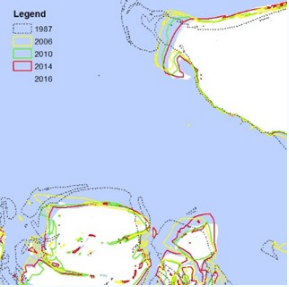
<h3 class="text-center">Case study example: Wadden Sea, the Netherlands</h3>
<img alt="" src="/assets/content/shoreline-mapping-case-study.PNG" style="float:left; height:349px; width:828px" />
<p>Figure 1. Morphology change over the Ems estuary 1987-2016 showing the contour lines in a sub-region (Lin, 2016).</p>
</div>


<p>For the highly dynamic Ems estuary in the Wadden Sea, images from different optical satellites (Landsat 5 and 8 and Sentinel-2) were used to visualise long-term changes. Water and land surfaces are classified using image-specific thresholds to extract the water surface area for each year from de NDWI images. Then, contour line of the water surface was generated for further investigation of changes.</p>

<h2>Limitations</h2>

<ul>
	<li>The output is the instantaneous shoreline without considering tides. Tidal level and/or beach profile are needed to compare changes over time.</li>
	<li>Spatial resolution and accuracy depend on the satellite data used in the analysis (30 m Landsat; 10 m Sentinel-2; less than 2 m with very high-resolution images).</li>
</ul>

<h2>&nbsp;</h2>
]]></content>
      <category>Basic service</category>
      <metaTitle>SHORELINE MAPPING</metaTitle>
      <metaDescription/>
      <uri>/articles/21/shoreline-mapping</uri>
      <articleContent>
        <articleContent>
          <articleId>21</articleId>
          <alpha3>eng</alpha3>
          <label/>
          <slug>shoreline-mapping</slug>
          <title>SHORELINE MAPPING</title>
          <subtitle/>
          <summary/>
          <lead>CoastObs maps changes of the land-water boundary over time based on satellite imagery</lead>
          <content><![CDATA[<h2>Why is it important?</h2>

<p>Coastal and especially estuarine environments are characterized by high sediment dynamics. The distribution of sediments over an area will change depending on discrete events (high river run-off, spring-tides) or gradual events (such as sea level rise) resulting in changes in coastline. Erosion will occur in high flow conditions and accretion in the opposite situation. A typical example of a dynamical coastal system with continuous coastline changes is a bird foot delta. Monitoring changes is important for local risk assessment and shoreline management.</p>

<h2>What does CoastObs offer?</h2>

<p>CoastObs can map the changes in land-water boundary over time. By using archived imagery, it is also possible to go back in time with a high resolution. Mapping of the land-water boundary is based on the Normalized Difference Water Index (NDWI; Mc.Feeters, 1996).</p>

<h2>How was the data validated?</h2>

<p>Satellite-retrieved Chl-a concentrations were validated against ground data collected close in time to the satellite overpass. The Chl-a samples collected by UVIGO, CNR, USTIR and HZ were analysed at University of Stirling using High Performance Liquid Chromatography (HPLC).</p>

<div class="light-blue">
<h3 class="text-center">Case study example: Wadden Sea, the Netherlands</h3>
<img alt="" src="/assets/content/shoreline-mapping-case-study.PNG" style="float:left; height:349px; width:828px" />
<p>Figure 1. Morphology change over the Ems estuary 1987-2016 showing the contour lines in a sub-region (Lin, 2016).</p>
</div>


<p>For the highly dynamic Ems estuary in the Wadden Sea, images from different optical satellites (Landsat 5 and 8 and Sentinel-2) were used to visualise long-term changes. Water and land surfaces are classified using image-specific thresholds to extract the water surface area for each year from de NDWI images. Then, contour line of the water surface was generated for further investigation of changes.</p>

<h2>Limitations</h2>

<ul>
	<li>The output is the instantaneous shoreline without considering tides. Tidal level and/or beach profile are needed to compare changes over time.</li>
	<li>Spatial resolution and accuracy depend on the satellite data used in the analysis (30 m Landsat; 10 m Sentinel-2; less than 2 m with very high-resolution images).</li>
</ul>

<h2>&nbsp;</h2>
]]></content>
          <metaTitle/>
          <metaDescription/>
          <updated>
            <date>2022-02-14 12:45:22.000000</date>
            <timezone_type>3</timezone_type>
            <timezone>UTC</timezone>
          </updated>
        </articleContent>
        <articleContent>
          <articleId>21</articleId>
          <alpha3>hun</alpha3>
          <label/>
          <slug/>
          <title/>
          <subtitle/>
          <summary/>
          <lead/>
          <content/>
          <metaTitle/>
          <metaDescription/>
          <updated>
            <date>2022-02-14 12:45:22.000000</date>
            <timezone_type>3</timezone_type>
            <timezone>UTC</timezone>
          </updated>
        </articleContent>
      </articleContent>
    </article>
  </basic>
  <innovative>
    <article>
      <articleId>22</articleId>
      <author/>
      <publishingDate>
        <date>2022-02-14 12:32:27.000000</date>
        <timezone_type>3</timezone_type>
        <timezone>UTC</timezone>
      </publishingDate>
      <status>published</status>
      <coverImage/>
      <largeThumbnail>articles/Thumbnails/11_IP_Phytoplankton-PP.png</largeThumbnail>
      <thumbnail>articles/Thumbnails/11_IP_Phytoplankton-PP.png</thumbnail>
      <articleCategoryId>6</articleCategoryId>
      <uuid>b7a72521-8d91-11ec-9a4e-000c292f0389</uuid>
      <updated>
        <date>2022-02-14 13:29:13.000000</date>
        <timezone_type>3</timezone_type>
        <timezone>UTC</timezone>
      </updated>
      <alpha3>eng</alpha3>
      <label/>
      <slug>phytoplankton-primary-production</slug>
      <title>PHYTOPLANKTON PRIMARY PRODUCTION</title>
      <subtitle/>
      <summary/>
      <lead>CoastObs uses Earth Observation and validated in-situ data to provide monitoring of phytoplankton primary production in coastal regions in Europe.</lead>
      <content><![CDATA[<h2>Why is it important?</h2>

<p>Phytoplankton plays a fundamental role in the marine food web, biogeochemical cycling and climatic processes. Estimating its spatiotemporal variations helps us understand biodiversity trends of other marine organisms and surface marine productivity, useful for ecosystem management, fisheries and aquaculture.</p>

<h2>What does CoastObs offer?</h2>

<p>CoastObs service provides an accurate and timely geospatial information as a result of combining satellite mapping and in-situ measurements, to present phytoplankton primary production concentration maps.</p>

<h2>How was the data validated?</h2>

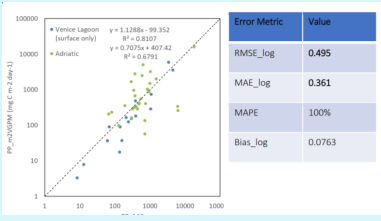
<p>The phytoplankton primary production product was validated against ground measurements of Fast Repetition Rate Fluorometry (used as an estimate of gross primary production) from Ria de Vigo, Atlantic coast, Venice lagoon and Adriatic. Past data collected by partners using the C-14 method were also used for validation of the modified VGPM model applied to Envisat MERIS data.</p>

<h3>&nbsp;</h3>

<p><img alt="" src="/assets/content/articles/coastobs-phytoplankton.PNG" style="height:221px; width:381px" /></p>

<p>Figure 1. Validation of m2VGPM with in situ data and associated errors</p>

<h2>&nbsp;</h2>
]]></content>
      <category>Innovative service</category>
      <metaTitle>PHYTOPLANKTON PRIMARY PRODUCTION</metaTitle>
      <metaDescription/>
      <uri>/articles/22/phytoplankton-primary-production</uri>
      <articleContent>
        <articleContent>
          <articleId>22</articleId>
          <alpha3>eng</alpha3>
          <label/>
          <slug>phytoplankton-primary-production</slug>
          <title>PHYTOPLANKTON PRIMARY PRODUCTION</title>
          <subtitle/>
          <summary/>
          <lead>CoastObs uses Earth Observation and validated in-situ data to provide monitoring of phytoplankton primary production in coastal regions in Europe.</lead>
          <content><![CDATA[<h2>Why is it important?</h2>

<p>Phytoplankton plays a fundamental role in the marine food web, biogeochemical cycling and climatic processes. Estimating its spatiotemporal variations helps us understand biodiversity trends of other marine organisms and surface marine productivity, useful for ecosystem management, fisheries and aquaculture.</p>

<h2>What does CoastObs offer?</h2>

<p>CoastObs service provides an accurate and timely geospatial information as a result of combining satellite mapping and in-situ measurements, to present phytoplankton primary production concentration maps.</p>

<h2>How was the data validated?</h2>

<p>The phytoplankton primary production product was validated against ground measurements of Fast Repetition Rate Fluorometry (used as an estimate of gross primary production) from Ria de Vigo, Atlantic coast, Venice lagoon and Adriatic. Past data collected by partners using the C-14 method were also used for validation of the modified VGPM model applied to Envisat MERIS data.</p>

<h3>&nbsp;</h3>

<p><img alt="" src="/assets/content/articles/coastobs-phytoplankton.PNG" style="height:221px; width:381px" /></p>

<p>Figure 1. Validation of m2VGPM with in situ data and associated errors</p>

<h2>&nbsp;</h2>
]]></content>
          <metaTitle/>
          <metaDescription/>
          <updated>
            <date>2022-02-14 13:29:13.000000</date>
            <timezone_type>3</timezone_type>
            <timezone>UTC</timezone>
          </updated>
        </articleContent>
        <articleContent>
          <articleId>22</articleId>
          <alpha3>hun</alpha3>
          <label/>
          <slug/>
          <title/>
          <subtitle/>
          <summary/>
          <lead/>
          <content/>
          <metaTitle/>
          <metaDescription/>
          <updated>
            <date>2022-02-14 13:29:13.000000</date>
            <timezone_type>3</timezone_type>
            <timezone>UTC</timezone>
          </updated>
        </articleContent>
      </articleContent>
    </article>
    <article>
      <articleId>23</articleId>
      <author/>
      <publishingDate>
        <date>2022-02-14 12:32:27.000000</date>
        <timezone_type>3</timezone_type>
        <timezone>UTC</timezone>
      </publishingDate>
      <status>published</status>
      <coverImage/>
      <largeThumbnail>articles/Thumbnails/10_IP_Seagrass-mapping.png</largeThumbnail>
      <thumbnail>articles/Thumbnails/10_IP_Seagrass-mapping.png</thumbnail>
      <articleCategoryId>6</articleCategoryId>
      <uuid>d0f1b405-8d92-11ec-9a4e-000c292f0389</uuid>
      <updated>
        <date>2022-02-14 13:37:05.000000</date>
        <timezone_type>3</timezone_type>
        <timezone>UTC</timezone>
      </updated>
      <alpha3>eng</alpha3>
      <label/>
      <slug>intertidal-seagrass-mapping</slug>
      <title>INTERTIDAL SEAGRASS MAPPING</title>
      <subtitle/>
      <summary/>
      <lead>CoastObs uses validated Earth Observation and in-situ data to monitor coastal ecosystem quality by providing frequent highresolution coverage of coastal regions in Europe.</lead>
      <content><![CDATA[<h2>Why is it important?</h2>

<p>Seagrass meadows are ecosystems considered as important blue-carbon sequesters and biodiversity reservoirs. They provide many environmental services, acting as nursery and habitat for a variety of marine flora and fauna, contributing to sediment stabilization and mitigating coastal erosion, and regulating nutrient cycles and water turbidity. Seagrass meadows are integrating indicators of the health status of coastal ecosystems due to their sensitivity to toxic substances, changes in nutrient balance, light availability, hydromorphology, and other human impacts.</p>

<h2>What does CoastObs offer?</h2>

<p>CoastObs provides validated maps of seagrass cover in intertidal areas. The maps are obtained from the high-resolution (10 m) Sentinel-2 satellite mission and could be used to monitor the status of intertidal seagrass meadows at both regional and continental scales, as well as to study their seasonal and interannual dynamics.</p>

<h2>How was the data validated?</h2>

<p>The algorithm to transform satellite data into biologically-relevant indicator (i.e., seagrass cover) was developed and validated in several study sites along the European Atlantic coast (namely the bays of Cadiz, Marennes-Oléron, and Bourgneuf), thus guarantying geographical robustness (see Zoffoli et al., 2020 for more details). Sentinel-2 maps of seagrass percent cover were successfully validated in 2018 and 2019 using a total of 64 in situ stations. In each station, seagrass percent cover was computed from the average of 5 squares of 0.25 m2 . The validation resulted in a root mean square difference (RMSD) of 14%, a bias of -2.09%, a mean absolute difference (MAD) of 10.45%, and a linear correlation with a R2 of 0.79 (p &lt; 0.001).</p>

<div class="light-blue">
<h3 class="text-center">Case study: seagrass percent cover in Bourgneuf Bay, France.</h3>

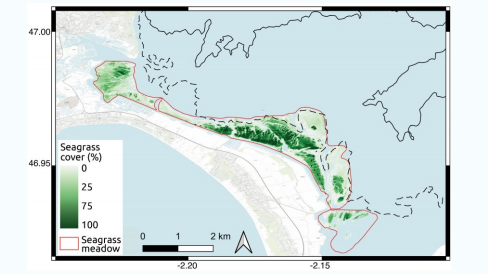
<p>Yearly Sentinel-2 maps of seagrass percent cover (SPC) were computed in Bourgneuf Bay since 2015, during the late summer seagrass seasonal maximum. The map of the 14 September 2018, which is shown as an example below, was selected from 23 satellite images acquired over that year. The high-spatial resolution (10 m) makes it possible to detect fine-scale features such as the fractal network of intertidal channels meandering within the seagrass meadow, to analyse the spatial distribution of the meadow, as well as to accurately measure the area of seagrass patches over a gradient of percent cover. The surface area of the dense meadow (i.e. seagrass percent cover &gt; 50%) can for example be accurately assessed and compared with the surface extent of the whole meadow. Such data is of valuable interest for coastal monitoring programs such as the Water Framework Directive because it provides a representative and spatial-rich indicator of the status of large seagrass ecosystems, unamenable to the sole field observations.</p>

<img alt="" src="/assets/content/intertidal-seagrass-mapping-case-study.PNG" style="float:left; height:349px; width:828px" />
<p>Figure 1. Seagrass cover map (in %) derived from Sentinel-2 data acquired on 14/Sep/2018 in Bourgneuf Bay, France</p>
</div>

]]></content>
      <category>Innovative service</category>
      <metaTitle>INTERTIDAL SEAGRASS MAPPING</metaTitle>
      <metaDescription/>
      <uri>/articles/23/intertidal-seagrass-mapping</uri>
      <articleContent>
        <articleContent>
          <articleId>23</articleId>
          <alpha3>eng</alpha3>
          <label/>
          <slug>intertidal-seagrass-mapping</slug>
          <title>INTERTIDAL SEAGRASS MAPPING</title>
          <subtitle/>
          <summary/>
          <lead>CoastObs uses validated Earth Observation and in-situ data to monitor coastal ecosystem quality by providing frequent highresolution coverage of coastal regions in Europe.</lead>
          <content><![CDATA[<h2>Why is it important?</h2>

<p>Seagrass meadows are ecosystems considered as important blue-carbon sequesters and biodiversity reservoirs. They provide many environmental services, acting as nursery and habitat for a variety of marine flora and fauna, contributing to sediment stabilization and mitigating coastal erosion, and regulating nutrient cycles and water turbidity. Seagrass meadows are integrating indicators of the health status of coastal ecosystems due to their sensitivity to toxic substances, changes in nutrient balance, light availability, hydromorphology, and other human impacts.</p>

<h2>What does CoastObs offer?</h2>

<p>CoastObs provides validated maps of seagrass cover in intertidal areas. The maps are obtained from the high-resolution (10 m) Sentinel-2 satellite mission and could be used to monitor the status of intertidal seagrass meadows at both regional and continental scales, as well as to study their seasonal and interannual dynamics.</p>

<h2>How was the data validated?</h2>

<p>The algorithm to transform satellite data into biologically-relevant indicator (i.e., seagrass cover) was developed and validated in several study sites along the European Atlantic coast (namely the bays of Cadiz, Marennes-Oléron, and Bourgneuf), thus guarantying geographical robustness (see Zoffoli et al., 2020 for more details). Sentinel-2 maps of seagrass percent cover were successfully validated in 2018 and 2019 using a total of 64 in situ stations. In each station, seagrass percent cover was computed from the average of 5 squares of 0.25 m2 . The validation resulted in a root mean square difference (RMSD) of 14%, a bias of -2.09%, a mean absolute difference (MAD) of 10.45%, and a linear correlation with a R2 of 0.79 (p &lt; 0.001).</p>

<div class="light-blue">
<h3 class="text-center">Case study: seagrass percent cover in Bourgneuf Bay, France.</h3>

<p>Yearly Sentinel-2 maps of seagrass percent cover (SPC) were computed in Bourgneuf Bay since 2015, during the late summer seagrass seasonal maximum. The map of the 14 September 2018, which is shown as an example below, was selected from 23 satellite images acquired over that year. The high-spatial resolution (10 m) makes it possible to detect fine-scale features such as the fractal network of intertidal channels meandering within the seagrass meadow, to analyse the spatial distribution of the meadow, as well as to accurately measure the area of seagrass patches over a gradient of percent cover. The surface area of the dense meadow (i.e. seagrass percent cover &gt; 50%) can for example be accurately assessed and compared with the surface extent of the whole meadow. Such data is of valuable interest for coastal monitoring programs such as the Water Framework Directive because it provides a representative and spatial-rich indicator of the status of large seagrass ecosystems, unamenable to the sole field observations.</p>

<img alt="" src="/assets/content/intertidal-seagrass-mapping-case-study.PNG" style="float:left; height:349px; width:828px" />
<p>Figure 1. Seagrass cover map (in %) derived from Sentinel-2 data acquired on 14/Sep/2018 in Bourgneuf Bay, France</p>
</div>

]]></content>
          <metaTitle/>
          <metaDescription/>
          <updated>
            <date>2022-02-14 13:37:05.000000</date>
            <timezone_type>3</timezone_type>
            <timezone>UTC</timezone>
          </updated>
        </articleContent>
        <articleContent>
          <articleId>23</articleId>
          <alpha3>hun</alpha3>
          <label/>
          <slug/>
          <title/>
          <subtitle/>
          <summary/>
          <lead/>
          <content/>
          <metaTitle/>
          <metaDescription/>
          <updated>
            <date>2022-02-14 13:37:05.000000</date>
            <timezone_type>3</timezone_type>
            <timezone>UTC</timezone>
          </updated>
        </articleContent>
      </articleContent>
    </article>
    <article>
      <articleId>24</articleId>
      <author/>
      <publishingDate>
        <date>2022-02-21 15:28:43.000000</date>
        <timezone_type>3</timezone_type>
        <timezone>UTC</timezone>
      </publishingDate>
      <status>published</status>
      <coverImage/>
      <largeThumbnail>articles/Thumbnails/12_IP_HAB-indicator.png</largeThumbnail>
      <thumbnail>articles/Thumbnails/12_IP_HAB-indicator.png</thumbnail>
      <articleCategoryId>6</articleCategoryId>
      <uuid>88aafffa-9328-11ec-9a4e-000c292f0389</uuid>
      <updated>
        <date>2022-02-21 16:11:24.000000</date>
        <timezone_type>3</timezone_type>
        <timezone>UTC</timezone>
      </updated>
      <alpha3>eng</alpha3>
      <label/>
      <slug>harmful-algal-blooms-hab-indicator</slug>
      <title>HARMFUL ALGAL BLOOMS (HAB) INDICATOR</title>
      <subtitle/>
      <summary/>
      <lead>CoastObs uses Earth Observation and validated in-situ data to provide harmful algal blooms forecasts in Europe.</lead>
      <content><![CDATA[<h2>Why is it important?</h2>

<p>Harmful algae blooms (HABs) in coastal marine systems are an increasingly frequent and intense event that affects the human and ecosystem health and impacts regional economies, specially the fish and aquaculture sector. Although it is not possible to prevent HABs occurrence, there is an increasing awareness of their effects and a growing interest in designing strategies to mitigate their impacts. The detection and monitoring of HABs is traditionally based on field samplings at fixed sampling stations. Indirect methods based on Earth Observation (EO) data (i.e., satellite images) are more cost-effective and produce map outputs providing a more complete view of the study area with a good temporal coverage, complementing the monitoring programs. Moreover, EO data can contribute to a better understanding of HABs dynamics.</p>

<h2>What does CoastObs offer?</h2>

<p>CoastObs provides species indicators for the direct detection of two HAB-forming taxonomic groups (Pseudo-nitzschia spp. and Alexandrium minutum), consisting of daily validated maps of abundance or bloom probability at a spatial resolution of 300 m.</p>

<h2>How was the data validated?</h2>

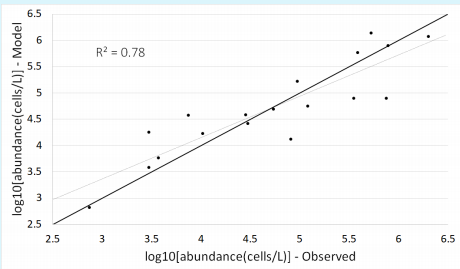
<p>Species indicators for both Pseudo-nitzschia spp. and Alexandrium minutum were validated against species abundance data obtained in the Rias Baixas area (Galicia) from two sources: samples collected during the CoastObs field campaigns in Vigo and public data of the Technological Institute for the Control of the Marine Environment of Galicia (INTECMAR). Figure shows the validation plot of the Alexandrium minutum indicator, comparing in situ and satellite-derived abundances in 2018 (R 2 = 0.78, p&lt;0.01; RMSE = 0.45). The Pseudo-nitzschia spp. indicator was validated in terms of binary classification (bloom or no bloom) computing a set of performance measurements as accuracy, sensitivity, or specificity. From April 2016 to September 2020, the indicator was able to identify correctly 87% of the blooms observed in the in-situ database (see D3.6 for more information).</p>

<p>&nbsp;</p>

<p><img alt="" src="/assets/content/articles/coastobs-harmful-fig.PNG" style="height:269px; width:460px" /></p>

<p>Figure 1. Validation of satellite-derived (Model) against in situ (Observed) A. minimum abundances acquired in 2018.</p>

<div class="light-blue">
<h3 class="text-center">Case study example: Pseudo-nitzschia spp. bloom probability maps in the Rias Baixas (Galicia)</h3>
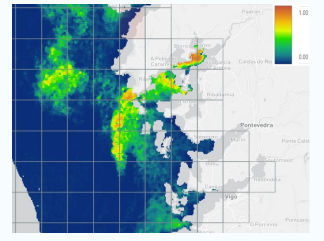
<p> Pseudo-nitzschia spp. is a common HAB-forming taxa in the Rias Baixas, where it impacts on
the extensive mussel culture. INTECMAR conducts a routine program on a weekly basis to
monitor HABs associated with Pseudo-nitzschia spp. and other species.
Figure shows an example of a Pseudo-nitzschia spp. bloom probability map on 18 June 2020.
These maps based on Sentinel-3 images can be produced operationally on a daily basis
(depending on the cloud cover). Maps are able to detect spatial distribution patterns, as well
as are useful for evaluating the evolution of Pseudo-nitzschia spp. abundance and
complement, to some extent, the information provided by the weekly monitoring program. </p>
<img alt="" src="/assets/content/articles/Coastobs-case-study-HAB.PNG" style="float:left; height:349px; width:828px" />
<p> Figure 2. Pseudo-nitzschia spp. bloom probability map on 18 June 2020.</p>
</div>
]]></content>
      <category>Innovative service</category>
      <metaTitle>HARMFUL ALGAL BLOOMS (HAB) INDICATOR</metaTitle>
      <metaDescription/>
      <uri>/articles/24/harmful-algal-blooms-hab-indicator</uri>
      <articleContent>
        <articleContent>
          <articleId>24</articleId>
          <alpha3>eng</alpha3>
          <label/>
          <slug>harmful-algal-blooms-hab-indicator</slug>
          <title>HARMFUL ALGAL BLOOMS (HAB) INDICATOR</title>
          <subtitle/>
          <summary/>
          <lead>CoastObs uses Earth Observation and validated in-situ data to provide harmful algal blooms forecasts in Europe.</lead>
          <content><![CDATA[<h2>Why is it important?</h2>

<p>Harmful algae blooms (HABs) in coastal marine systems are an increasingly frequent and intense event that affects the human and ecosystem health and impacts regional economies, specially the fish and aquaculture sector. Although it is not possible to prevent HABs occurrence, there is an increasing awareness of their effects and a growing interest in designing strategies to mitigate their impacts. The detection and monitoring of HABs is traditionally based on field samplings at fixed sampling stations. Indirect methods based on Earth Observation (EO) data (i.e., satellite images) are more cost-effective and produce map outputs providing a more complete view of the study area with a good temporal coverage, complementing the monitoring programs. Moreover, EO data can contribute to a better understanding of HABs dynamics.</p>

<h2>What does CoastObs offer?</h2>

<p>CoastObs provides species indicators for the direct detection of two HAB-forming taxonomic groups (Pseudo-nitzschia spp. and Alexandrium minutum), consisting of daily validated maps of abundance or bloom probability at a spatial resolution of 300 m.</p>

<h2>How was the data validated?</h2>

<p>Species indicators for both Pseudo-nitzschia spp. and Alexandrium minutum were validated against species abundance data obtained in the Rias Baixas area (Galicia) from two sources: samples collected during the CoastObs field campaigns in Vigo and public data of the Technological Institute for the Control of the Marine Environment of Galicia (INTECMAR). Figure shows the validation plot of the Alexandrium minutum indicator, comparing in situ and satellite-derived abundances in 2018 (R 2 = 0.78, p&lt;0.01; RMSE = 0.45). The Pseudo-nitzschia spp. indicator was validated in terms of binary classification (bloom or no bloom) computing a set of performance measurements as accuracy, sensitivity, or specificity. From April 2016 to September 2020, the indicator was able to identify correctly 87% of the blooms observed in the in-situ database (see D3.6 for more information).</p>

<p>&nbsp;</p>

<p><img alt="" src="/assets/content/articles/coastobs-harmful-fig.PNG" style="height:269px; width:460px" /></p>

<p>Figure 1. Validation of satellite-derived (Model) against in situ (Observed) A. minimum abundances acquired in 2018.</p>

<div class="light-blue">
<h3 class="text-center">Case study example: Pseudo-nitzschia spp. bloom probability maps in the Rias Baixas (Galicia)</h3>
<p> Pseudo-nitzschia spp. is a common HAB-forming taxa in the Rias Baixas, where it impacts on
the extensive mussel culture. INTECMAR conducts a routine program on a weekly basis to
monitor HABs associated with Pseudo-nitzschia spp. and other species.
Figure shows an example of a Pseudo-nitzschia spp. bloom probability map on 18 June 2020.
These maps based on Sentinel-3 images can be produced operationally on a daily basis
(depending on the cloud cover). Maps are able to detect spatial distribution patterns, as well
as are useful for evaluating the evolution of Pseudo-nitzschia spp. abundance and
complement, to some extent, the information provided by the weekly monitoring program. </p>
<img alt="" src="/assets/content/articles/Coastobs-case-study-HAB.PNG" style="float:left; height:349px; width:828px" />
<p> Figure 2. Pseudo-nitzschia spp. bloom probability map on 18 June 2020.</p>
</div>
]]></content>
          <metaTitle/>
          <metaDescription/>
          <updated>
            <date>2022-02-21 16:11:24.000000</date>
            <timezone_type>3</timezone_type>
            <timezone>UTC</timezone>
          </updated>
        </articleContent>
        <articleContent>
          <articleId>24</articleId>
          <alpha3>hun</alpha3>
          <label/>
          <slug/>
          <title/>
          <subtitle/>
          <summary/>
          <lead/>
          <content/>
          <metaTitle/>
          <metaDescription/>
          <updated>
            <date>2022-02-21 16:11:24.000000</date>
            <timezone_type>3</timezone_type>
            <timezone>UTC</timezone>
          </updated>
        </articleContent>
      </articleContent>
    </article>
    <article>
      <articleId>25</articleId>
      <author/>
      <publishingDate>
        <date>2022-02-21 15:28:43.000000</date>
        <timezone_type>3</timezone_type>
        <timezone>UTC</timezone>
      </publishingDate>
      <status>published</status>
      <coverImage/>
      <largeThumbnail>articles/Thumbnails/13_IP_Phytoplankton-size-classes.png</largeThumbnail>
      <thumbnail>articles/Thumbnails/13_IP_Phytoplankton-size-classes.png</thumbnail>
      <articleCategoryId>6</articleCategoryId>
      <uuid>861d46c1-9331-11ec-9a4e-000c292f0389</uuid>
      <updated>
        <date>2022-02-21 17:15:45.000000</date>
        <timezone_type>3</timezone_type>
        <timezone>UTC</timezone>
      </updated>
      <alpha3>eng</alpha3>
      <label/>
      <slug>phytoplankton-size-classes-psc</slug>
      <title>PHYTOPLANKTON SIZE CLASSES (PSC)</title>
      <subtitle/>
      <summary/>
      <lead>CoastObs uses Earth Observation and validated in-situ data to provide PSC maps in Europe.</lead>
      <content><![CDATA[<h2>Why is it important?</h2>

<p>The size structure of phytoplankton communities has implications for food chain length and the energy transfer efficiency to zooplankton. For example, being phytoplankton recognised as the primary source of food for cultured mussels, small phytoplankton (&lt;5 μm) are often not efficiently retained as food and therefore phytoplankton size can affect bivalve growth and condition. Knowing the phytoplankton primary productions is of relevance to carbon cycling, fisheries &amp; aquaculture management.</p>

<h2>What does CoastObs offer?</h2>

<p>CoastObs service provides an accurate and timely geospatial information as a result of combining satellite mapping, modelling and in-situ measurements, to present PSC maps at a spatial/temporal resolution of 300m (daily).</p>

<h2>How was the data validated?</h2>

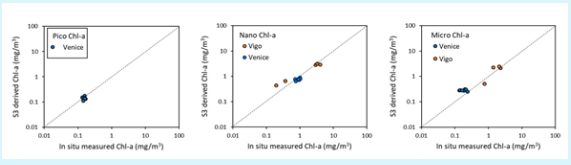
<p>The PSC product was validated using ground data of fractionated Chl-a and spectral absorption from Vigo and Venice. This product is currently being validated over Dutch coastal waters using the pigment profile. The Figures below show an example of the in-situ model performance for nano- and micro-phytoplankton at Venice and Vigo using the 2018 data.</p>

<p>&nbsp;</p>

<p><img alt="" src="/assets/content/articles/coastobs-psc-figure.PNG" style="height:165px; width:571px" /></p>

<p>Figure 1. Validation of S3-OLCI CoastObs products over Venice and Vigo for pico-phytoplankton, nanophytoplankton and micro-phytoplankton using only the 2018 ground data.</p>

<p>&nbsp;</p>

<div class="light-blue">
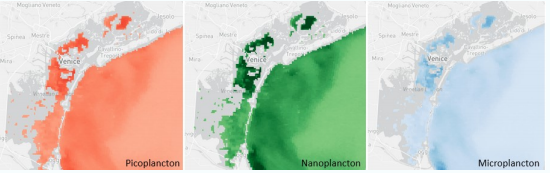
<h3 class="text-center">Case study example: Phytoplankton size classes in Venice.</h3>
<img alt="" src="/assets/content/psc-venice.PNG" style="float:left; height:349px; width:828px" />
<p>Figure 1. Phytoplankton size classes in Venice.</p>
</div>

<h2>Limitations</h2>
Specific to different retrieval approaches and availability of representative datasets. Availability depends on cloud cover.]]></content>
      <category>Innovative service</category>
      <metaTitle>PHYTOPLANKTON SIZE CLASSES (PSC)</metaTitle>
      <metaDescription/>
      <uri>/articles/25/phytoplankton-size-classes-psc</uri>
      <articleContent>
        <articleContent>
          <articleId>25</articleId>
          <alpha3>eng</alpha3>
          <label/>
          <slug>phytoplankton-size-classes-psc</slug>
          <title>PHYTOPLANKTON SIZE CLASSES (PSC)</title>
          <subtitle/>
          <summary/>
          <lead>CoastObs uses Earth Observation and validated in-situ data to provide PSC maps in Europe.</lead>
          <content><![CDATA[<h2>Why is it important?</h2>

<p>The size structure of phytoplankton communities has implications for food chain length and the energy transfer efficiency to zooplankton. For example, being phytoplankton recognised as the primary source of food for cultured mussels, small phytoplankton (&lt;5 μm) are often not efficiently retained as food and therefore phytoplankton size can affect bivalve growth and condition. Knowing the phytoplankton primary productions is of relevance to carbon cycling, fisheries &amp; aquaculture management.</p>

<h2>What does CoastObs offer?</h2>

<p>CoastObs service provides an accurate and timely geospatial information as a result of combining satellite mapping, modelling and in-situ measurements, to present PSC maps at a spatial/temporal resolution of 300m (daily).</p>

<h2>How was the data validated?</h2>

<p>The PSC product was validated using ground data of fractionated Chl-a and spectral absorption from Vigo and Venice. This product is currently being validated over Dutch coastal waters using the pigment profile. The Figures below show an example of the in-situ model performance for nano- and micro-phytoplankton at Venice and Vigo using the 2018 data.</p>

<p>&nbsp;</p>

<p><img alt="" src="/assets/content/articles/coastobs-psc-figure.PNG" style="height:165px; width:571px" /></p>

<p>Figure 1. Validation of S3-OLCI CoastObs products over Venice and Vigo for pico-phytoplankton, nanophytoplankton and micro-phytoplankton using only the 2018 ground data.</p>

<p>&nbsp;</p>

<div class="light-blue">
<h3 class="text-center">Case study example: Phytoplankton size classes in Venice.</h3>
<img alt="" src="/assets/content/psc-venice.PNG" style="float:left; height:349px; width:828px" />
<p>Figure 1. Phytoplankton size classes in Venice.</p>
</div>

<h2>Limitations</h2>
Specific to different retrieval approaches and availability of representative datasets. Availability depends on cloud cover.]]></content>
          <metaTitle/>
          <metaDescription/>
          <updated>
            <date>2022-02-21 17:15:45.000000</date>
            <timezone_type>3</timezone_type>
            <timezone>UTC</timezone>
          </updated>
        </articleContent>
        <articleContent>
          <articleId>25</articleId>
          <alpha3>hun</alpha3>
          <label/>
          <slug/>
          <title/>
          <subtitle/>
          <summary/>
          <lead/>
          <content/>
          <metaTitle/>
          <metaDescription/>
          <updated>
            <date>2022-02-21 17:15:45.000000</date>
            <timezone_type>3</timezone_type>
            <timezone>UTC</timezone>
          </updated>
        </articleContent>
      </articleContent>
    </article>
  </innovative>
  <higherLevel>
    <article>
      <articleId>26</articleId>
      <author/>
      <publishingDate>
        <date>2022-02-21 15:28:43.000000</date>
        <timezone_type>3</timezone_type>
        <timezone>UTC</timezone>
      </publishingDate>
      <status>published</status>
      <coverImage/>
      <largeThumbnail>articles/Thumbnails/14_HLP_Statistics.png</largeThumbnail>
      <thumbnail>articles/Thumbnails/14_HLP_Statistics.png</thumbnail>
      <articleCategoryId>5</articleCategoryId>
      <uuid>066c6248-9333-11ec-9a4e-000c292f0389</uuid>
      <updated>
        <date>2022-02-21 17:26:30.000000</date>
        <timezone_type>3</timezone_type>
        <timezone>UTC</timezone>
      </updated>
      <alpha3>eng</alpha3>
      <label/>
      <slug>statistics-aggregation</slug>
      <title>STATISTICS/ AGGREGATION</title>
      <subtitle/>
      <summary/>
      <lead>CoastObs uses Earth Observation to aggregate important variables for shellfish growth.</lead>
      <content><![CDATA[<h2>Why is it important?</h2>

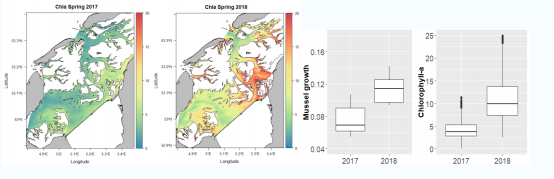
<p>Statistics and/or aggregation of basic products provide meaningful insights when day to day variation is high. Maps of seasonal or yearly averages can be used to compare year to year variation and spatial aggregation of pixels can be used for comparison of different areas or for the purpose of suitability analyses. Shellfish growth for example, peaks during spring season when temperatures rise and phytoplankton starts to bloom. Inter-annual comparison of spring season averages can give insight in shellfish growth patterns.</p>

<h2>What does CoastObs offer?</h2>

<p>CoastObs provides seasonal and annual maps of average food quantity and food quality for shellfish. The aggregated maps are based on the 300m Sentinel 3 basic products: the ratio Chlorophyll-a relative to Total Suspended Matter is used as a measure for food quality, and chlorophyll-a for food quantity. Maps like these are helpful to compare annual variation of important drivers for shellfish growth and also to gain insight in spatial variation of these parameters.</p>

<h2>How was the data validated?</h2>

<p>For aggregation and statistics, the validated basic products I Chlorophyll-a and II Total Suspended Matter are used. All valid pixels of a study area within a certain time frame are averaged to create one map representing that specific time frame or season. In case of food quality, the average value of each Chlorophyll-a pixel is divided by the average pixel value of Total Suspended Matter to create a map of average Food Quality for an area.</p>

<div class="light-blue">
<h3 class="text-center">Case study example: Seasonal food quantity in the Wadden Sea</h3>
<img alt="" src="/assets/content/articles/statistics-figure.PNG" style="float:left; height:349px; width:828px" />
<p>Figure 1. Maps of average spring Chl-a concentrations (left) and the average mussel growth rate of the same two years (right)</p>
</div>

<h2>Limitations</h2>
<p> Linked to limitations of basis products Chlorophyll-a and Total Suspended Matter.</p>]]></content>
      <category>Higher-level service</category>
      <metaTitle>STATISTICS/ AGGREGATION</metaTitle>
      <metaDescription/>
      <uri>/articles/26/statistics-aggregation</uri>
      <articleContent>
        <articleContent>
          <articleId>26</articleId>
          <alpha3>eng</alpha3>
          <label/>
          <slug>statistics-aggregation</slug>
          <title>STATISTICS/ AGGREGATION</title>
          <subtitle/>
          <summary/>
          <lead>CoastObs uses Earth Observation to aggregate important variables for shellfish growth.</lead>
          <content><![CDATA[<h2>Why is it important?</h2>

<p>Statistics and/or aggregation of basic products provide meaningful insights when day to day variation is high. Maps of seasonal or yearly averages can be used to compare year to year variation and spatial aggregation of pixels can be used for comparison of different areas or for the purpose of suitability analyses. Shellfish growth for example, peaks during spring season when temperatures rise and phytoplankton starts to bloom. Inter-annual comparison of spring season averages can give insight in shellfish growth patterns.</p>

<h2>What does CoastObs offer?</h2>

<p>CoastObs provides seasonal and annual maps of average food quantity and food quality for shellfish. The aggregated maps are based on the 300m Sentinel 3 basic products: the ratio Chlorophyll-a relative to Total Suspended Matter is used as a measure for food quality, and chlorophyll-a for food quantity. Maps like these are helpful to compare annual variation of important drivers for shellfish growth and also to gain insight in spatial variation of these parameters.</p>

<h2>How was the data validated?</h2>

<p>For aggregation and statistics, the validated basic products I Chlorophyll-a and II Total Suspended Matter are used. All valid pixels of a study area within a certain time frame are averaged to create one map representing that specific time frame or season. In case of food quality, the average value of each Chlorophyll-a pixel is divided by the average pixel value of Total Suspended Matter to create a map of average Food Quality for an area.</p>

<div class="light-blue">
<h3 class="text-center">Case study example: Seasonal food quantity in the Wadden Sea</h3>
<img alt="" src="/assets/content/articles/statistics-figure.PNG" style="float:left; height:349px; width:828px" />
<p>Figure 1. Maps of average spring Chl-a concentrations (left) and the average mussel growth rate of the same two years (right)</p>
</div>

<h2>Limitations</h2>
<p> Linked to limitations of basis products Chlorophyll-a and Total Suspended Matter.</p>]]></content>
          <metaTitle/>
          <metaDescription/>
          <updated>
            <date>2022-02-21 17:26:30.000000</date>
            <timezone_type>3</timezone_type>
            <timezone>UTC</timezone>
          </updated>
        </articleContent>
        <articleContent>
          <articleId>26</articleId>
          <alpha3>hun</alpha3>
          <label/>
          <slug/>
          <title/>
          <subtitle/>
          <summary/>
          <lead/>
          <content/>
          <metaTitle/>
          <metaDescription/>
          <updated>
            <date>2022-02-21 17:26:30.000000</date>
            <timezone_type>3</timezone_type>
            <timezone>UTC</timezone>
          </updated>
        </articleContent>
      </articleContent>
    </article>
    <article>
      <articleId>27</articleId>
      <author/>
      <publishingDate>
        <date>2022-02-21 15:28:43.000000</date>
        <timezone_type>3</timezone_type>
        <timezone>UTC</timezone>
      </publishingDate>
      <status>published</status>
      <coverImage/>
      <largeThumbnail>articles/Thumbnails/15_HLP_Indicators.png</largeThumbnail>
      <thumbnail>articles/Thumbnails/15_HLP_Indicators.png</thumbnail>
      <articleCategoryId>5</articleCategoryId>
      <uuid>023d571b-9335-11ec-9a4e-000c292f0389</uuid>
      <updated>
        <date>2022-02-21 17:40:42.000000</date>
        <timezone_type>3</timezone_type>
        <timezone>UTC</timezone>
      </updated>
      <alpha3>eng</alpha3>
      <label/>
      <slug>indicators-for-water-framework-directive-reporting</slug>
      <title>INDICATORS FOR WATER FRAMEWORK DIRECTIVE REPORTING</title>
      <subtitle/>
      <summary/>
      <lead>CoastObs uses Earth Observation data to with spatial monitoring data to the WFD reporting.</lead>
      <content><![CDATA[<h2>Why is it important?</h2>

<p>Good water quality is the basis of a healthy ecosystem with rich biodiversity. Aquatic ecosystems also provide essential services for drinking water, irrigation, recreation, aquaculture and fisheries. The EU Water Framework Directive recognizes this and requires member states to monitor and, if necessary, improve water quality. Although the spatial component is key to gaining insight into water processes, regular sample-based monitoring only provides point data.</p>

<h2>What does CoastObs offer?</h2>

<p>WFD relevant products can be based for example on satellite-based chlorophyll-a maps (feeding into WFD phytoplankton abundance), on satellite-based turbidity maps (feeding into WFD transparency) or on seagrass percentual coverage maps. CoastObs offers several products for the WFD status based on EO data:</p>

<ul>
	<li>Pixel extracts at specific locations: time series at certain points. These can be treated as data points in the same way as time series from in situ measurements. Calculating e.g. the P90 over time provides a temporally aggregated result, which can be classified according to the WFD thresholds. This option will probably increase the frequency of the data availability in comparison to (only) manual sampling.</li>
	<li>Applying the WFD thresholds on each satellite image. This will generate a series of maps with the spatial distribution of the WFD classes and allow users to take advantage of the spatial component of Earth Observation data. This can help to understand the system: where is the status good, or moderate, or bad? Why is that the case, and which measures would therefore be the most effective? It can also help to determine if the in situ sampling stations are located at representative and strategic locations.</li>
	<li>Spatial aggregation over a WFD area. A global average over a region along a series of images can be used to calculate the P90 over time. The result is a spatial-temporal aggregate, which can be classified according to the WFD thresholds. Such aggregates can be presented as histograms, e.g. P90 values over time and space.</li>
</ul>

<h2>How was the data validated?</h2>

<p>The accuracy of the WFD products directly relates to the accuracy of the Chl-a, turbidity, seagrass coverage or other product that was used as input (which are illustrated elsewhere in this document). The applicability of earth observation (EO) data for WFD reporting was illustrated in detail by the H2020 EOMORES and CoastObs white paper "Satellite-assisted monitoring of water quality to support the implementation of the Water Framework Directive". Details of the case study can be found in D3.8 higher-level products.</p>

<div class="light-blue">
<h3 class="text-center">Case study example: Wadden Sea</h3>

<p>The Ems estuary is part of the Wadden Sea; it is a highly dynamic area. Although there are several in situ monitoring stations, the spatial variations are still hard to catch. We used this area to illustrate two of the above-mentioned types of products for WFD reporting.</p>
<img alt="" src="/assets/content/SST_Galicia.PNG" style="float:left; height:349px; width:828px" />
<p>Figure 1. Map of the Sea Surface Tempature in the coast of Galicia, Spain.</p>

<p>&nbsp;</p>
<img alt="" src="/assets/content/articles/case-study-waddensea1.PNG" style="float:left; height:349px; margin-top:15px; width:828px" />
<p>&nbsp;</p>

<p>&nbsp;</p>

<p>&nbsp;</p>

<p>&nbsp;</p>

<p>&nbsp;</p>

<p>&nbsp;</p>

<p>Figure 2. Histogram showing the number of satellite pixels in each class. This example is based on one satellite image, for reporting purposes a complete year of imagery could be intergrated.</p>
</div>
]]></content>
      <category>Higher-level service</category>
      <metaTitle>INDICATORS FOR WATER FRAMEWORK DIRECTIVE REPORTING</metaTitle>
      <metaDescription/>
      <uri>/articles/27/indicators-for-water-framework-directive-reporting</uri>
      <articleContent>
        <articleContent>
          <articleId>27</articleId>
          <alpha3>eng</alpha3>
          <label/>
          <slug>indicators-for-water-framework-directive-reporting</slug>
          <title>INDICATORS FOR WATER FRAMEWORK DIRECTIVE REPORTING</title>
          <subtitle/>
          <summary/>
          <lead>CoastObs uses Earth Observation data to with spatial monitoring data to the WFD reporting.</lead>
          <content><![CDATA[<h2>Why is it important?</h2>

<p>Good water quality is the basis of a healthy ecosystem with rich biodiversity. Aquatic ecosystems also provide essential services for drinking water, irrigation, recreation, aquaculture and fisheries. The EU Water Framework Directive recognizes this and requires member states to monitor and, if necessary, improve water quality. Although the spatial component is key to gaining insight into water processes, regular sample-based monitoring only provides point data.</p>

<h2>What does CoastObs offer?</h2>

<p>WFD relevant products can be based for example on satellite-based chlorophyll-a maps (feeding into WFD phytoplankton abundance), on satellite-based turbidity maps (feeding into WFD transparency) or on seagrass percentual coverage maps. CoastObs offers several products for the WFD status based on EO data:</p>

<ul>
	<li>Pixel extracts at specific locations: time series at certain points. These can be treated as data points in the same way as time series from in situ measurements. Calculating e.g. the P90 over time provides a temporally aggregated result, which can be classified according to the WFD thresholds. This option will probably increase the frequency of the data availability in comparison to (only) manual sampling.</li>
	<li>Applying the WFD thresholds on each satellite image. This will generate a series of maps with the spatial distribution of the WFD classes and allow users to take advantage of the spatial component of Earth Observation data. This can help to understand the system: where is the status good, or moderate, or bad? Why is that the case, and which measures would therefore be the most effective? It can also help to determine if the in situ sampling stations are located at representative and strategic locations.</li>
	<li>Spatial aggregation over a WFD area. A global average over a region along a series of images can be used to calculate the P90 over time. The result is a spatial-temporal aggregate, which can be classified according to the WFD thresholds. Such aggregates can be presented as histograms, e.g. P90 values over time and space.</li>
</ul>

<h2>How was the data validated?</h2>

<p>The accuracy of the WFD products directly relates to the accuracy of the Chl-a, turbidity, seagrass coverage or other product that was used as input (which are illustrated elsewhere in this document). The applicability of earth observation (EO) data for WFD reporting was illustrated in detail by the H2020 EOMORES and CoastObs white paper "Satellite-assisted monitoring of water quality to support the implementation of the Water Framework Directive". Details of the case study can be found in D3.8 higher-level products.</p>

<div class="light-blue">
<h3 class="text-center">Case study example: Wadden Sea</h3>

<p>The Ems estuary is part of the Wadden Sea; it is a highly dynamic area. Although there are several in situ monitoring stations, the spatial variations are still hard to catch. We used this area to illustrate two of the above-mentioned types of products for WFD reporting.</p>
<img alt="" src="/assets/content/SST_Galicia.PNG" style="float:left; height:349px; width:828px" />
<p>Figure 1. Map of the Sea Surface Tempature in the coast of Galicia, Spain.</p>

<p>&nbsp;</p>
<img alt="" src="/assets/content/articles/case-study-waddensea1.PNG" style="float:left; height:349px; margin-top:15px; width:828px" />
<p>&nbsp;</p>

<p>&nbsp;</p>

<p>&nbsp;</p>

<p>&nbsp;</p>

<p>&nbsp;</p>

<p>&nbsp;</p>

<p>Figure 2. Histogram showing the number of satellite pixels in each class. This example is based on one satellite image, for reporting purposes a complete year of imagery could be intergrated.</p>
</div>
]]></content>
          <metaTitle/>
          <metaDescription/>
          <updated>
            <date>2022-02-21 17:40:42.000000</date>
            <timezone_type>3</timezone_type>
            <timezone>UTC</timezone>
          </updated>
        </articleContent>
        <articleContent>
          <articleId>27</articleId>
          <alpha3>hun</alpha3>
          <label/>
          <slug/>
          <title/>
          <subtitle/>
          <summary/>
          <lead/>
          <content/>
          <metaTitle/>
          <metaDescription/>
          <updated>
            <date>2022-02-21 17:40:42.000000</date>
            <timezone_type>3</timezone_type>
            <timezone>UTC</timezone>
          </updated>
        </articleContent>
      </articleContent>
    </article>
    <article>
      <articleId>28</articleId>
      <author/>
      <publishingDate>
        <date>2022-02-21 15:28:43.000000</date>
        <timezone_type>3</timezone_type>
        <timezone>UTC</timezone>
      </publishingDate>
      <status>published</status>
      <coverImage/>
      <largeThumbnail>articles/Thumbnails/16_HLP_HAB-forecast.png</largeThumbnail>
      <thumbnail>articles/Thumbnails/16_HLP_HAB-forecast.png</thumbnail>
      <articleCategoryId>5</articleCategoryId>
      <uuid>a148994d-9336-11ec-9a4e-000c292f0389</uuid>
      <updated>
        <date>2022-02-21 17:52:18.000000</date>
        <timezone_type>3</timezone_type>
        <timezone>UTC</timezone>
      </updated>
      <alpha3>eng</alpha3>
      <label/>
      <slug>harmful-algal-blooms-hab-forecasts</slug>
      <title>HARMFUL ALGAL BLOOMS (HAB) FORECASTS</title>
      <subtitle/>
      <summary/>
      <lead>CoastObs uses Earth Observation and validated in-situ data to provide harmful algal blooms forecasts in Europe.</lead>
      <content><![CDATA[<h2>Why is it important?</h2>

<p>Harmful Algal Blooms (HABs) are considered one of the most dangerous threats to coastal ecosystems worldwide in terms of biodiversity preservation and food security. HABs forecasting models integrating Earth Observation (EO) data and other environmental parameters can contribute to a better management of aquaculture activities to mitigate the HABs impact. Forecasting tools are of great interest to monitoring authorities and aquaculture producers.</p>

<h2>What does CoastObs offer?</h2>

<p>CoastObs provides a service based on a set of advanced and basic models to forecast Pseudonitzschia spp. blooms in the Rias Baixas (Galicia). Model output is defined as the probability of a toxic bloom causing the closure of a production area (Amnesic Shellfish Poisoning or ASP closure) in a ria between 1 and 5 days after the modelling date. Basic models use as input upwelling indices (freely available from NOAA or IEO) as well as temperature and chlorophyll concentrations from Sentinel-3 images. Advanced models incorporate also nutrient concentrations, i.e. nitrate, nitrite, phosphate and silicate.</p>

<h2>How was the data validated?</h2>

<p>Forecasting models for Galicia were developed and validated using historical data (including ASP closures) provided by the monitoring centre (INTECMAR) as well as data from MERIS (2002-2012) and Sentinel 3 (2016-2018). Models performance was evaluated as a binary classification (bloom or no bloom). Overall, models show sensitivity (% of bloom correctly classified) values over 70%. Advance models show also good specificity (% of no bloom correctly classified) values over 80%, while basic models show a lower specificity and hence higher false alarm rates (see complete results in D3.8).</p>

<div class="light-blue">
<h3 class="text-center">Case study example: Pseudo-nitzschia spp. bloom forecasting in Galicia</h3>
<p>Figure shows the results of the advanced forecasting model at day +3 for the Ria de Muros between 2004 and 2005. Overall, the model is able to follow the pattern observed in the insitu database with only one false positive.</p>
<img alt="" src="/assets/content/articles/coastobs-HAB.PNG" style="float:left; height:349px; width:828px" />
<p>Figure 1. ASP closure probability observed (0: closed; 1: opened) and predicted using the advanced mode (day +3) for the Ria de Muros between 2004 and 2005.</p>
</div>

<h2>Required input</h2>

<p>Advanced models require nutrient concentrations. Nowadays, these data are not operationally available from the monitoring program or other public services in Galicia. However, they could be available in other areas or be provided by potential users.</p>

<h2>Limitations</h2>

<ul>
	<li>Models with a higher sensitivity tend to produce more false alarms due to the unequal distribution of both classes in the input dataset (~ 85 % of no bloom).</li>
</ul>

<p>&nbsp;</p>
]]></content>
      <category>Higher-level service</category>
      <metaTitle>HARMFUL ALGAL BLOOMS (HAB) FORECASTS</metaTitle>
      <metaDescription/>
      <uri>/articles/28/harmful-algal-blooms-hab-forecasts</uri>
      <articleContent>
        <articleContent>
          <articleId>28</articleId>
          <alpha3>eng</alpha3>
          <label/>
          <slug>harmful-algal-blooms-hab-forecasts</slug>
          <title>HARMFUL ALGAL BLOOMS (HAB) FORECASTS</title>
          <subtitle/>
          <summary/>
          <lead>CoastObs uses Earth Observation and validated in-situ data to provide harmful algal blooms forecasts in Europe.</lead>
          <content><![CDATA[<h2>Why is it important?</h2>

<p>Harmful Algal Blooms (HABs) are considered one of the most dangerous threats to coastal ecosystems worldwide in terms of biodiversity preservation and food security. HABs forecasting models integrating Earth Observation (EO) data and other environmental parameters can contribute to a better management of aquaculture activities to mitigate the HABs impact. Forecasting tools are of great interest to monitoring authorities and aquaculture producers.</p>

<h2>What does CoastObs offer?</h2>

<p>CoastObs provides a service based on a set of advanced and basic models to forecast Pseudonitzschia spp. blooms in the Rias Baixas (Galicia). Model output is defined as the probability of a toxic bloom causing the closure of a production area (Amnesic Shellfish Poisoning or ASP closure) in a ria between 1 and 5 days after the modelling date. Basic models use as input upwelling indices (freely available from NOAA or IEO) as well as temperature and chlorophyll concentrations from Sentinel-3 images. Advanced models incorporate also nutrient concentrations, i.e. nitrate, nitrite, phosphate and silicate.</p>

<h2>How was the data validated?</h2>

<p>Forecasting models for Galicia were developed and validated using historical data (including ASP closures) provided by the monitoring centre (INTECMAR) as well as data from MERIS (2002-2012) and Sentinel 3 (2016-2018). Models performance was evaluated as a binary classification (bloom or no bloom). Overall, models show sensitivity (% of bloom correctly classified) values over 70%. Advance models show also good specificity (% of no bloom correctly classified) values over 80%, while basic models show a lower specificity and hence higher false alarm rates (see complete results in D3.8).</p>

<div class="light-blue">
<h3 class="text-center">Case study example: Pseudo-nitzschia spp. bloom forecasting in Galicia</h3>
<p>Figure shows the results of the advanced forecasting model at day +3 for the Ria de Muros between 2004 and 2005. Overall, the model is able to follow the pattern observed in the insitu database with only one false positive.</p>
<img alt="" src="/assets/content/articles/coastobs-HAB.PNG" style="float:left; height:349px; width:828px" />
<p>Figure 1. ASP closure probability observed (0: closed; 1: opened) and predicted using the advanced mode (day +3) for the Ria de Muros between 2004 and 2005.</p>
</div>

<h2>Required input</h2>

<p>Advanced models require nutrient concentrations. Nowadays, these data are not operationally available from the monitoring program or other public services in Galicia. However, they could be available in other areas or be provided by potential users.</p>

<h2>Limitations</h2>

<ul>
	<li>Models with a higher sensitivity tend to produce more false alarms due to the unequal distribution of both classes in the input dataset (~ 85 % of no bloom).</li>
</ul>

<p>&nbsp;</p>
]]></content>
          <metaTitle/>
          <metaDescription/>
          <updated>
            <date>2022-02-21 17:52:18.000000</date>
            <timezone_type>3</timezone_type>
            <timezone>UTC</timezone>
          </updated>
        </articleContent>
        <articleContent>
          <articleId>28</articleId>
          <alpha3>hun</alpha3>
          <label/>
          <slug/>
          <title/>
          <subtitle/>
          <summary/>
          <lead/>
          <content/>
          <metaTitle/>
          <metaDescription/>
          <updated>
            <date>2022-02-21 17:52:18.000000</date>
            <timezone_type>3</timezone_type>
            <timezone>UTC</timezone>
          </updated>
        </articleContent>
      </articleContent>
    </article>
    <article>
      <articleId>29</articleId>
      <author/>
      <publishingDate>
        <date>2022-02-21 15:28:43.000000</date>
        <timezone_type>3</timezone_type>
        <timezone>UTC</timezone>
      </publishingDate>
      <status>published</status>
      <coverImage/>
      <largeThumbnail>articles/Thumbnails/17_HLP_Shellfish.png</largeThumbnail>
      <thumbnail>articles/Thumbnails/17_HLP_Shellfish.png</thumbnail>
      <articleCategoryId>5</articleCategoryId>
      <uuid>45ff9301-9337-11ec-9a4e-000c292f0389</uuid>
      <updated>
        <date>2022-02-21 17:56:54.000000</date>
        <timezone_type>3</timezone_type>
        <timezone>UTC</timezone>
      </updated>
      <alpha3>eng</alpha3>
      <label/>
      <slug>shellfish-culture-potential</slug>
      <title>SHELLFISH CULTURE POTENTIAL</title>
      <subtitle/>
      <summary/>
      <lead>CoastObs integrates validated basic products with growth modelling of shellfish to identify the growth potential of shellfish.</lead>
      <content><![CDATA[<h2>Why is it important?</h2>

<p>Numerical models relating environmental variables, like food quantity and water temperature to shellfish growth can be helpful for optimization and management of shellfish culture sites, for spatial suitability analysis, and in understanding the dynamics of bivalve growth in an estuary or bay as a whole.</p>

<h2>What does CoastObs offer?</h2>

<p>CoastObs integrates spatio-temporal data of S3 basic products Chlorophyll-a, Total Suspended Matter and Sea Surface Temperature with the Dynamic Energy Budget theory for shellfish. Model output generally indicates for every pixel the growth potential in terms of shell length increase, but can be tailored to users wishes if desired (e.g. monthly maps or even daily if desired). Maps of shellfish culture potential are available for Blue mussels (Mytilus edulis) in the Dutch Wadden Sea and Oosterschelde estuary and the Mediterranean mussel (Mytilus provincialis) in the Spanish Galician Rias.</p>

<h2>How was the data validated?</h2>

<p>Goodness-of-fit was evaluated by linear regression between Dutch field observations of 2017 and 2018 (Mussel length) and the simulation mussel length output with S3 Chl-a, TSM and SST input. This model was then tested against the model Y=X at an α error threshold of 5%. Validation resulted in a linear correlation with overall R2 = 0.82.</p>

<div class="light-blue">
<h3 class="text-center">Case study example: Dutch Wadden Sea and Galician Rias</h3>
<p> Shell length (cm) at harvest in 2017 is shown below for the Galician Rias (left image), while shell growth rate (mm/day) in 2017 is displayed for the Dutch Wadden Sea (right image) indicating the variable output possibilities for this higher level product. Grey areas indicate land, shellfish cultivation areas are indicated with black squares or polygons. </p>
<img alt="" src="/assets/content/articles/case-study-shellfish.PNG" style="height:230px; width:531px" style="float:left; height:349px; width:828px" />
<p>Figure 1. Maps of shell length (left) and shell growth rate (right)</p>
</div>
]]></content>
      <category>Higher-level service</category>
      <metaTitle>SHELLFISH CULTURE POTENTIAL</metaTitle>
      <metaDescription/>
      <uri>/articles/29/shellfish-culture-potential</uri>
      <articleContent>
        <articleContent>
          <articleId>29</articleId>
          <alpha3>eng</alpha3>
          <label/>
          <slug>shellfish-culture-potential</slug>
          <title>SHELLFISH CULTURE POTENTIAL</title>
          <subtitle/>
          <summary/>
          <lead>CoastObs integrates validated basic products with growth modelling of shellfish to identify the growth potential of shellfish.</lead>
          <content><![CDATA[<h2>Why is it important?</h2>

<p>Numerical models relating environmental variables, like food quantity and water temperature to shellfish growth can be helpful for optimization and management of shellfish culture sites, for spatial suitability analysis, and in understanding the dynamics of bivalve growth in an estuary or bay as a whole.</p>

<h2>What does CoastObs offer?</h2>

<p>CoastObs integrates spatio-temporal data of S3 basic products Chlorophyll-a, Total Suspended Matter and Sea Surface Temperature with the Dynamic Energy Budget theory for shellfish. Model output generally indicates for every pixel the growth potential in terms of shell length increase, but can be tailored to users wishes if desired (e.g. monthly maps or even daily if desired). Maps of shellfish culture potential are available for Blue mussels (Mytilus edulis) in the Dutch Wadden Sea and Oosterschelde estuary and the Mediterranean mussel (Mytilus provincialis) in the Spanish Galician Rias.</p>

<h2>How was the data validated?</h2>

<p>Goodness-of-fit was evaluated by linear regression between Dutch field observations of 2017 and 2018 (Mussel length) and the simulation mussel length output with S3 Chl-a, TSM and SST input. This model was then tested against the model Y=X at an α error threshold of 5%. Validation resulted in a linear correlation with overall R2 = 0.82.</p>

<div class="light-blue">
<h3 class="text-center">Case study example: Dutch Wadden Sea and Galician Rias</h3>
<p> Shell length (cm) at harvest in 2017 is shown below for the Galician Rias (left image), while shell growth rate (mm/day) in 2017 is displayed for the Dutch Wadden Sea (right image) indicating the variable output possibilities for this higher level product. Grey areas indicate land, shellfish cultivation areas are indicated with black squares or polygons. </p>
<img alt="" src="/assets/content/articles/case-study-shellfish.PNG" style="height:230px; width:531px" style="float:left; height:349px; width:828px" />
<p>Figure 1. Maps of shell length (left) and shell growth rate (right)</p>
</div>
]]></content>
          <metaTitle/>
          <metaDescription/>
          <updated>
            <date>2022-02-21 17:56:54.000000</date>
            <timezone_type>3</timezone_type>
            <timezone>UTC</timezone>
          </updated>
        </articleContent>
        <articleContent>
          <articleId>29</articleId>
          <alpha3>hun</alpha3>
          <label/>
          <slug/>
          <title/>
          <subtitle/>
          <summary/>
          <lead/>
          <content/>
          <metaTitle/>
          <metaDescription/>
          <updated>
            <date>2022-02-21 17:56:54.000000</date>
            <timezone_type>3</timezone_type>
            <timezone>UTC</timezone>
          </updated>
        </articleContent>
      </articleContent>
    </article>
    <article>
      <articleId>30</articleId>
      <author/>
      <publishingDate>
        <date>2022-02-21 15:28:43.000000</date>
        <timezone_type>3</timezone_type>
        <timezone>UTC</timezone>
      </publishingDate>
      <status>published</status>
      <coverImage/>
      <largeThumbnail>articles/Thumbnails/18_Phytoplanktpn-phenology.png</largeThumbnail>
      <thumbnail>articles/Thumbnails/18_Phytoplanktpn-phenology.png</thumbnail>
      <articleCategoryId>5</articleCategoryId>
      <uuid>3dfa4929-9338-11ec-9a4e-000c292f0389</uuid>
      <updated>
        <date>2022-02-21 18:03:50.000000</date>
        <timezone_type>3</timezone_type>
        <timezone>UTC</timezone>
      </updated>
      <alpha3>eng</alpha3>
      <label/>
      <slug>phytoplankton-bloom-phenology</slug>
      <title>PHYTOPLANKTON BLOOM PHENOLOGY</title>
      <subtitle/>
      <summary/>
      <lead>CoastObs uses series of satellite imagery to analyse phytoplankton bloom appearance, intensity and lasting</lead>
      <content><![CDATA[<h2>Why is it important?</h2>

<p>The study of the phytoplankton seasonal cycle (phenology) is relevant to understanding the functioning of the marine ecosystem. Phytoplankton bloom phenology addresses the question: when is how much of the phytoplankton where? Changes in phenology affect ecosystem functioning and productivity and have an impact on higher trophic levels and – via fisheries and aquaculture – on economic activities and food production. Phenology is also a sensitive indicator of climate change. Therefore, phytoplankton bloom phenology is of interest to environmental monitoring and management authorities as well as to aquaculture and fisheries regulators and producers. So far, phenological indicators have not been readily available, therefore uptake of this information has been limited.</p>

<h2>What does CoastObs offer?</h2>

<p>CoastObs offers yearly information on the following phenology metrics for the dominant phytoplankton bloom, subject to further discussion with the end-users:</p>

<ul>
	<li>Start timing (day of year)</li>
	<li>End timing (day of year)</li>
	<li>Length (days)</li>
	<li>Peak timing (day of year)</li>
	<li>Base concentration (mg m−3 )</li>
	<li>Maximum concentration (mg m−3 )</li>
	<li>Amplitude (mg m−3 )</li>
	<li>Number of distinct blooms per year</li>
</ul>

<p>For reporting regions or individual pixels, averages of the phenology metrics will be calculated and presented as graphs</p>

<h2>How was the data validated?</h2>

<p>Satellite-retrieved Chl-a concentrations were validated against ground data collected close in time to the satellite overpass. The Chl-a samples collected by UVIGO, CNR, USTIR and HZ were analysed at University of Stirling using High Performance Liquid Chromatography (HPLC).</p>

<p><img alt="" src="/assets/content/articles/phenology1.PNG" style="height:280px; width:438px" /></p>

<p>Figure 1. Example of a Chl-a plot indicating some of the phenological parameters. Each bar could be a an average of a certain region. For simplicity, this plot shows monthly data, but time series can be made on a daily basis (depending on cloud cover) if preferred.</p>

<p>Additionally, for each of the phenology parameters, a trend analysis can be performed over the total period covered by the service on a pixel-by-pixel basis based on the existence and significance of a linear trend. The results of the trend analysis can be presented as a trend map per parameter</p>

<p><img alt="" src="/assets/content/articles/phenology2.PNG" style="height:273px; width:483px" /></p>

<p>Figure 2. Start, end and peak of the phytoplankton bloom in different years. The different colours of the peak stand for different intensities of the peak.</p>

<h2>Limitations</h2>

<ul>
	<li>Quality of retrieval depends on sensor characteristics, can be impacted by high suspended sediment or CDOM concentrations.</li>
	<li>In shallow waters, bottom visibility can interfere with the signal.</li>
	<li>Availability depends on cloud cover</li>
</ul>

<h2>Area Covered</h2>

<p>We can cover any coastal area you may need.</p>
]]></content>
      <category>Higher-level service</category>
      <metaTitle>PHYTOPLANKTON BLOOM PHENOLOGY</metaTitle>
      <metaDescription/>
      <uri>/articles/30/phytoplankton-bloom-phenology</uri>
      <articleContent>
        <articleContent>
          <articleId>30</articleId>
          <alpha3>eng</alpha3>
          <label/>
          <slug>phytoplankton-bloom-phenology</slug>
          <title>PHYTOPLANKTON BLOOM PHENOLOGY</title>
          <subtitle/>
          <summary/>
          <lead>CoastObs uses series of satellite imagery to analyse phytoplankton bloom appearance, intensity and lasting</lead>
          <content><![CDATA[<h2>Why is it important?</h2>

<p>The study of the phytoplankton seasonal cycle (phenology) is relevant to understanding the functioning of the marine ecosystem. Phytoplankton bloom phenology addresses the question: when is how much of the phytoplankton where? Changes in phenology affect ecosystem functioning and productivity and have an impact on higher trophic levels and – via fisheries and aquaculture – on economic activities and food production. Phenology is also a sensitive indicator of climate change. Therefore, phytoplankton bloom phenology is of interest to environmental monitoring and management authorities as well as to aquaculture and fisheries regulators and producers. So far, phenological indicators have not been readily available, therefore uptake of this information has been limited.</p>

<h2>What does CoastObs offer?</h2>

<p>CoastObs offers yearly information on the following phenology metrics for the dominant phytoplankton bloom, subject to further discussion with the end-users:</p>

<ul>
	<li>Start timing (day of year)</li>
	<li>End timing (day of year)</li>
	<li>Length (days)</li>
	<li>Peak timing (day of year)</li>
	<li>Base concentration (mg m−3 )</li>
	<li>Maximum concentration (mg m−3 )</li>
	<li>Amplitude (mg m−3 )</li>
	<li>Number of distinct blooms per year</li>
</ul>

<p>For reporting regions or individual pixels, averages of the phenology metrics will be calculated and presented as graphs</p>

<h2>How was the data validated?</h2>

<p>Satellite-retrieved Chl-a concentrations were validated against ground data collected close in time to the satellite overpass. The Chl-a samples collected by UVIGO, CNR, USTIR and HZ were analysed at University of Stirling using High Performance Liquid Chromatography (HPLC).</p>

<p><img alt="" src="/assets/content/articles/phenology1.PNG" style="height:280px; width:438px" /></p>

<p>Figure 1. Example of a Chl-a plot indicating some of the phenological parameters. Each bar could be a an average of a certain region. For simplicity, this plot shows monthly data, but time series can be made on a daily basis (depending on cloud cover) if preferred.</p>

<p>Additionally, for each of the phenology parameters, a trend analysis can be performed over the total period covered by the service on a pixel-by-pixel basis based on the existence and significance of a linear trend. The results of the trend analysis can be presented as a trend map per parameter</p>

<p><img alt="" src="/assets/content/articles/phenology2.PNG" style="height:273px; width:483px" /></p>

<p>Figure 2. Start, end and peak of the phytoplankton bloom in different years. The different colours of the peak stand for different intensities of the peak.</p>

<h2>Limitations</h2>

<ul>
	<li>Quality of retrieval depends on sensor characteristics, can be impacted by high suspended sediment or CDOM concentrations.</li>
	<li>In shallow waters, bottom visibility can interfere with the signal.</li>
	<li>Availability depends on cloud cover</li>
</ul>

<h2>Area Covered</h2>

<p>We can cover any coastal area you may need.</p>
]]></content>
          <metaTitle/>
          <metaDescription/>
          <updated>
            <date>2022-02-21 18:03:50.000000</date>
            <timezone_type>3</timezone_type>
            <timezone>UTC</timezone>
          </updated>
        </articleContent>
        <articleContent>
          <articleId>30</articleId>
          <alpha3>hun</alpha3>
          <label/>
          <slug/>
          <title/>
          <subtitle/>
          <summary/>
          <lead/>
          <content/>
          <metaTitle/>
          <metaDescription/>
          <updated>
            <date>2022-02-21 18:03:50.000000</date>
            <timezone_type>3</timezone_type>
            <timezone>UTC</timezone>
          </updated>
        </articleContent>
      </articleContent>
    </article>
    <article>
      <articleId>31</articleId>
      <author/>
      <publishingDate>
        <date>2022-02-21 15:28:43.000000</date>
        <timezone_type>3</timezone_type>
        <timezone>UTC</timezone>
      </publishingDate>
      <status>published</status>
      <coverImage/>
      <largeThumbnail>articles/Thumbnails/sediment _148×148px.png</largeThumbnail>
      <thumbnail>articles/Thumbnails/sediment_64x64.png</thumbnail>
      <articleCategoryId>5</articleCategoryId>
      <uuid>9a7a4ac3-9339-11ec-9a4e-000c292f0389</uuid>
      <updated>
        <date>2022-02-21 18:13:35.000000</date>
        <timezone_type>3</timezone_type>
        <timezone>UTC</timezone>
      </updated>
      <alpha3>eng</alpha3>
      <label/>
      <slug>sediment-plume-morphology</slug>
      <title>SEDIMENT PLUME MORPHOLOGY</title>
      <subtitle/>
      <summary/>
      <lead>CoastObs uses Earth Observation and validated in-situ data to provide monitoring of plume morphology in estuaries</lead>
      <content><![CDATA[<h2>Why is it important?</h2>

<p>Monitoring turbid sediment plumes at the mouth of estuaries and analysing their meteorological and oceanographic drivers is important to mitigate the impact of dredging activities on the coastal ecosystems. In all European estuaries, navigable waterways and harbours are regularly dredged. The dumping of dredged sediments locally modifies the water quality by increasing the concentration of total suspended particulate matter (TSM). The impact of such activities is currently little documented. If not properly managed, the excess of TSM resulting from sediment dredging and dumping could result in limiting the underwater light for primary producers and re-suspending organic matter from the hypoxic seabed and bottom water into the water column. The degradation of this organic material by bacteria will consume oxygen and ultimately lead to anoxia with deleterious effects on the marine biota.</p>

<h2>What does CoastObs offer?</h2>

<p>CoastObs service provides accurate and timely geospatial information as a result of combining satellite mapping and in-situ measurements, resulting in maps of sediment plumes at a spatial resolution of 10m (Sentinel 2) to 30 m (Landsat 8) with a moderate temporal resolution (at best 5 days). The different plume morphologies were classified and statistically related to the prevailing environmental conditions (e.g. wind, tide, river flow) to identify temporal windows for dredging operations that would have the lowest impact on the environment. The product is however still under development and not fully operational yet.</p>

<h2>How was the data validated?</h2>

<p>TSM maps are obtained using regional algorithms validated with in situ measurements over a wide range of turbidity (see TSM product).</p>

<div class="light-blue">
<h3 class="text-center">Case study example: Sediment plume morphology in the Loire estuary</h3>
<p>SPM (=TSM) spatial distribution maps of the Loire estuary were used to derive simple metrics describing the plume morphology. The plume length was estimated from a reference point for three turbidity classes. The objective was to relate the plume metrics to estuarine/hydrological conditions to identify periods when dredging activities would have the lowest environmental impact. A preliminary analysis suggested that the main variables explaining the plume morphologies were the river flow and the tidal range while the wind direction and strength had a lower influence. CoastObs is developing this product for the port of Nantes/Saint-Nazaire in order to reduce the environmental impact of its dredging activities.</p>
<img alt="" src="/assets/content/articles/Thumbnails/19_TOBETRANSFORMED_Sediment-Plume.JPG" style="float:left; height:349px; width:828px" />
<p>Figure 1. Suspended particulate matter (SPM) map in the Loire Estuary, France. The color dots show the plume length (from a reference point) for three SPM classes</p>
</div>
]]></content>
      <category>Higher-level service</category>
      <metaTitle>SEDIMENT PLUME MORPHOLOGY</metaTitle>
      <metaDescription/>
      <uri>/articles/31/sediment-plume-morphology</uri>
      <articleContent>
        <articleContent>
          <articleId>31</articleId>
          <alpha3>eng</alpha3>
          <label/>
          <slug>sediment-plume-morphology</slug>
          <title>SEDIMENT PLUME MORPHOLOGY</title>
          <subtitle/>
          <summary/>
          <lead>CoastObs uses Earth Observation and validated in-situ data to provide monitoring of plume morphology in estuaries</lead>
          <content><![CDATA[<h2>Why is it important?</h2>

<p>Monitoring turbid sediment plumes at the mouth of estuaries and analysing their meteorological and oceanographic drivers is important to mitigate the impact of dredging activities on the coastal ecosystems. In all European estuaries, navigable waterways and harbours are regularly dredged. The dumping of dredged sediments locally modifies the water quality by increasing the concentration of total suspended particulate matter (TSM). The impact of such activities is currently little documented. If not properly managed, the excess of TSM resulting from sediment dredging and dumping could result in limiting the underwater light for primary producers and re-suspending organic matter from the hypoxic seabed and bottom water into the water column. The degradation of this organic material by bacteria will consume oxygen and ultimately lead to anoxia with deleterious effects on the marine biota.</p>

<h2>What does CoastObs offer?</h2>

<p>CoastObs service provides accurate and timely geospatial information as a result of combining satellite mapping and in-situ measurements, resulting in maps of sediment plumes at a spatial resolution of 10m (Sentinel 2) to 30 m (Landsat 8) with a moderate temporal resolution (at best 5 days). The different plume morphologies were classified and statistically related to the prevailing environmental conditions (e.g. wind, tide, river flow) to identify temporal windows for dredging operations that would have the lowest impact on the environment. The product is however still under development and not fully operational yet.</p>

<h2>How was the data validated?</h2>

<p>TSM maps are obtained using regional algorithms validated with in situ measurements over a wide range of turbidity (see TSM product).</p>

<div class="light-blue">
<h3 class="text-center">Case study example: Sediment plume morphology in the Loire estuary</h3>
<p>SPM (=TSM) spatial distribution maps of the Loire estuary were used to derive simple metrics describing the plume morphology. The plume length was estimated from a reference point for three turbidity classes. The objective was to relate the plume metrics to estuarine/hydrological conditions to identify periods when dredging activities would have the lowest environmental impact. A preliminary analysis suggested that the main variables explaining the plume morphologies were the river flow and the tidal range while the wind direction and strength had a lower influence. CoastObs is developing this product for the port of Nantes/Saint-Nazaire in order to reduce the environmental impact of its dredging activities.</p>
<img alt="" src="/assets/content/articles/Thumbnails/19_TOBETRANSFORMED_Sediment-Plume.JPG" style="float:left; height:349px; width:828px" />
<p>Figure 1. Suspended particulate matter (SPM) map in the Loire Estuary, France. The color dots show the plume length (from a reference point) for three SPM classes</p>
</div>
]]></content>
          <metaTitle/>
          <metaDescription/>
          <updated>
            <date>2022-02-21 18:13:35.000000</date>
            <timezone_type>3</timezone_type>
            <timezone>UTC</timezone>
          </updated>
        </articleContent>
        <articleContent>
          <articleId>31</articleId>
          <alpha3>hun</alpha3>
          <label/>
          <slug/>
          <title/>
          <subtitle/>
          <summary/>
          <lead/>
          <content/>
          <metaTitle/>
          <metaDescription/>
          <updated>
            <date>2022-02-21 18:13:35.000000</date>
            <timezone_type>3</timezone_type>
            <timezone>UTC</timezone>
          </updated>
        </articleContent>
      </articleContent>
    </article>
  </higherLevel>
  <waterQualityData>
    <article>
      <articleId>32</articleId>
      <author/>
      <publishingDate>
        <date>2022-02-21 15:28:43.000000</date>
        <timezone_type>3</timezone_type>
        <timezone>UTC</timezone>
      </publishingDate>
      <status>published</status>
      <coverImage/>
      <largeThumbnail>articles/Thumbnails/20_A_In-situ.png</largeThumbnail>
      <thumbnail>articles/Thumbnails/20_A_In-situ.png</thumbnail>
      <articleCategoryId>7</articleCategoryId>
      <uuid>9e263570-933a-11ec-9a4e-000c292f0389</uuid>
      <updated>
        <date>2022-02-21 18:20:51.000000</date>
        <timezone_type>3</timezone_type>
        <timezone>UTC</timezone>
      </updated>
      <alpha3>eng</alpha3>
      <label/>
      <slug>in-situ-data-for-eo-validation</slug>
      <title>IN SITU DATA FOR EO VALIDATION</title>
      <subtitle/>
      <summary/>
      <lead>CoastObs products are scientifically validated to ensure a high quality. Sometimes it might be wanted or required to perform additional validation before application in new areas.</lead>
      <content><![CDATA[<h2>Why is it important?</h2>

<p>In situ data is used for validation of CoastObs data. Sometimes this is necessary, for local tuning of algorithms, sometimes it is required to match existing long-term datasets with the new data, and sometimes users want the CoastObs data to be validated on their own site to be sure it performs as required.</p>

<h2>What does CoastObs offer?</h2>

<p>CoastObs provides validation based on in situ field surveys, or sampling followed by analysis in the laboratory, and by in situ optical measures. Users can also provide their own in situ datasets to for validation, CoastObs will then provide a validation of the CoastObs data with these in situ data. In situ field surveys are carried out of example for observations of Seagrass coverage. This is done according to standard methods. Also, manual sampling and the following processing in the laboratory is done according to standard protocols, e.g. with HPLC analysis for Chl-a, dryweight for TSM, or Fast Repetition rate Fluorometry for phytoplankton primary production. Optical methods for validation could include manual screening with instruments such as a WISP-3 optical sensor, or semi-continuous measurements with a WISPstation. These methods provide reflectance data comparable to optical satellites, and are very suitable for validation of satellite imagery.</p>

<h2>How was the data validated?</h2>

<p>Dedicated field campaigns were carried out at the different regions to validate all CoastObs products. Hundreds of stations were sampled and thousands of samples were collected and analysed using standard protocols and state-of-the-art equipment to develop and assess our products.</p>

<p>This included core biogeochemical parameters (e.g. chl-a, TSM, turbidity), optical parameters (e.g. remote sensing reflectance, phytoplankton absorption coefficient, particulate scattering coefficient) as well as a number of parameters (e.g. phytoplankton abundance, fractionated chl-a, macrophytes, pigment profile, Primary production) to validate our innovative products. Users might not be familiar with the optical methods. The figure below therefore provides an insight in the validation results of the WISPstation with traditional in situ methods.</p>

<p><img alt="" src="/assets/content/articles/additionalservices-water-quality.PNG" style="height:109px; width:569px" /></p>

<p><img alt="" src="/assets/content/figure-additionalservices.PNG" style="height:256px; width:358px" /></p>

<p>Figure 1. WISPstation Chl-a validated against in situ sampled Chl-a from different regions (source: Riddick et al., 2019)</p>
]]></content>
      <category>Water-quality data service</category>
      <metaTitle>IN SITU DATA FOR EO VALIDATION</metaTitle>
      <metaDescription/>
      <uri>/articles/32/in-situ-data-for-eo-validation</uri>
      <articleContent>
        <articleContent>
          <articleId>32</articleId>
          <alpha3>eng</alpha3>
          <label/>
          <slug>in-situ-data-for-eo-validation</slug>
          <title>IN SITU DATA FOR EO VALIDATION</title>
          <subtitle/>
          <summary/>
          <lead>CoastObs products are scientifically validated to ensure a high quality. Sometimes it might be wanted or required to perform additional validation before application in new areas.</lead>
          <content><![CDATA[<h2>Why is it important?</h2>

<p>In situ data is used for validation of CoastObs data. Sometimes this is necessary, for local tuning of algorithms, sometimes it is required to match existing long-term datasets with the new data, and sometimes users want the CoastObs data to be validated on their own site to be sure it performs as required.</p>

<h2>What does CoastObs offer?</h2>

<p>CoastObs provides validation based on in situ field surveys, or sampling followed by analysis in the laboratory, and by in situ optical measures. Users can also provide their own in situ datasets to for validation, CoastObs will then provide a validation of the CoastObs data with these in situ data. In situ field surveys are carried out of example for observations of Seagrass coverage. This is done according to standard methods. Also, manual sampling and the following processing in the laboratory is done according to standard protocols, e.g. with HPLC analysis for Chl-a, dryweight for TSM, or Fast Repetition rate Fluorometry for phytoplankton primary production. Optical methods for validation could include manual screening with instruments such as a WISP-3 optical sensor, or semi-continuous measurements with a WISPstation. These methods provide reflectance data comparable to optical satellites, and are very suitable for validation of satellite imagery.</p>

<h2>How was the data validated?</h2>

<p>Dedicated field campaigns were carried out at the different regions to validate all CoastObs products. Hundreds of stations were sampled and thousands of samples were collected and analysed using standard protocols and state-of-the-art equipment to develop and assess our products.</p>

<p>This included core biogeochemical parameters (e.g. chl-a, TSM, turbidity), optical parameters (e.g. remote sensing reflectance, phytoplankton absorption coefficient, particulate scattering coefficient) as well as a number of parameters (e.g. phytoplankton abundance, fractionated chl-a, macrophytes, pigment profile, Primary production) to validate our innovative products. Users might not be familiar with the optical methods. The figure below therefore provides an insight in the validation results of the WISPstation with traditional in situ methods.</p>

<p><img alt="" src="/assets/content/articles/additionalservices-water-quality.PNG" style="height:109px; width:569px" /></p>

<p><img alt="" src="/assets/content/figure-additionalservices.PNG" style="height:256px; width:358px" /></p>

<p>Figure 1. WISPstation Chl-a validated against in situ sampled Chl-a from different regions (source: Riddick et al., 2019)</p>
]]></content>
          <metaTitle/>
          <metaDescription/>
          <updated>
            <date>2022-02-21 18:20:51.000000</date>
            <timezone_type>3</timezone_type>
            <timezone>UTC</timezone>
          </updated>
        </articleContent>
        <articleContent>
          <articleId>32</articleId>
          <alpha3>hun</alpha3>
          <label/>
          <slug/>
          <title/>
          <subtitle/>
          <summary/>
          <lead/>
          <content/>
          <metaTitle/>
          <metaDescription/>
          <updated>
            <date>2022-02-21 18:20:51.000000</date>
            <timezone_type>3</timezone_type>
            <timezone>UTC</timezone>
          </updated>
        </articleContent>
      </articleContent>
    </article>
  </waterQualityData>
</articles>