<?xml version="1.0" encoding="UTF-8"?>
<news xmlns="http://coastobs.eu" xmlns:xsi="http://www.w3.org/2001/XMLSchema-instance" xsi="http://coastobs.eu/news/37/coastobs-at-seatech-week.xsi">
  <newsId>37</newsId>
  <date>
    <date>2020-10-16 16:11:02.000000</date>
    <timezone_type>3</timezone_type>
    <timezone>UTC</timezone>
  </date>
  <publishingDate>
    <date>2020-10-16 00:00:00.000000</date>
    <timezone_type>3</timezone_type>
    <timezone>UTC</timezone>
  </publishingDate>
  <expirationDate/>
  <thumbnail>CoastObs_SeaTechWeek.png</thumbnail>
  <status>published</status>
  <uuid>f6b24b00-c542-44a3-8966-c54881b6c754</uuid>
  <updated>
    <date>2020-12-02 16:11:02.000000</date>
    <timezone_type>3</timezone_type>
    <timezone>UTC</timezone>
  </updated>
  <alpha3>eng</alpha3>
  <subject>CoastObs at SeaTech week</subject>
  <slug/>
  <lead><![CDATA[<p>CoastObs presented at the SeaTech week the work "<em>Sentinel-2 remote sensing of Zostera noltei-domindated intertidal grass meadows</em>" which took place between October 12-16th, 2020 online.&nbsp;</p>

<p>&nbsp;</p>
]]></lead>
  <content><![CDATA[<p>&nbsp;</p>

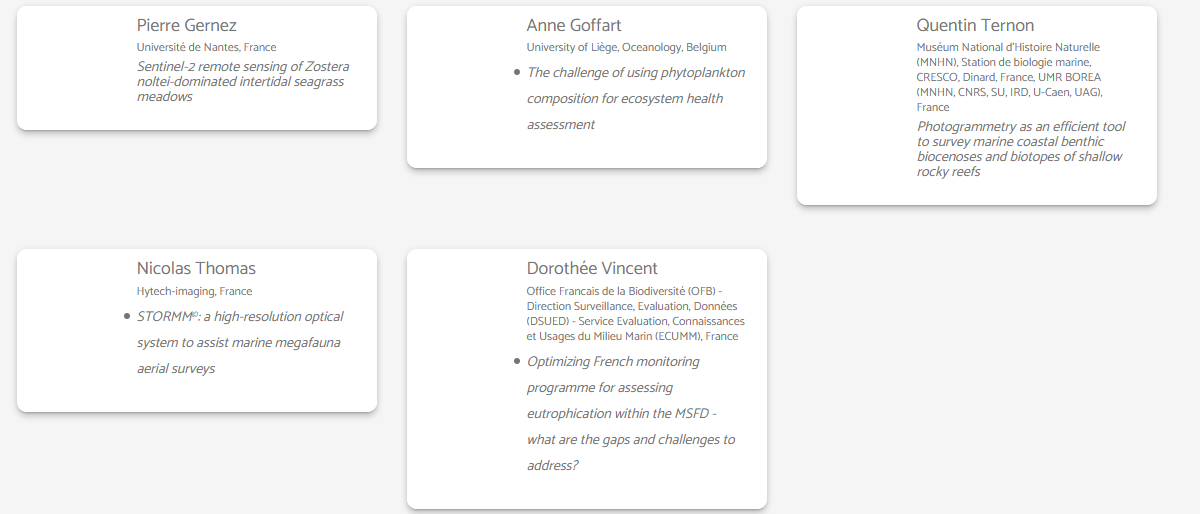
<p>In a session hosted and organized by Julie Charmasson and Estérelle Vignemale from the Office Français de la Biodiversité (OFB), CoastObs, through our colleague Pierre Gernez from the University of Nantes, presented our work under the session "New technologies for marine environment monitoring and management policies".&nbsp;</p>

<p><img alt="" class="img-responsive" src="https://coastobs.eu/assets/content/seatech_p1.png" style="margin-bottom:0.6em; margin-right:1em" /></p>

<p><img alt="" class="img-responsive" src="https://coastobs.eu/assets/content/seatech_p2.png" style="margin-bottom:0.6em; margin-right:1em" /></p>

<p>The presentation is fruit of the recently published paper in the Remote Sensing of Environment journal, which proposes a method to map seagrass cover in exposed intertidal meadows.&nbsp;Since accurate habitat mapping methods are urgently required for the monitoring, conservation, and management of blue carbon ecosystems and their associated services, the recently published paper is of great relevance as the work carried out&nbsp;demonstrates that satellite remote sensing can be used to map seagrass percent cover and leaf biomass, and to further characterize its seasonal dynamics.&nbsp;</p>

<p>&nbsp;</p>

<p>To access the full paper please visit:</p>

<p><a href="https://www.sciencedirect.com/science/article/pii/S0034425720303904" target="_blank">https://www.sciencedirect.com/science/article/pii/S0034425720303904</a></p>

<p>&nbsp;</p>

<p>If you want to check the presentation delivered at the SeaTech week, click on the image below:</p>

<p><a href="https://coastobs.eu/assets/content/Gernez_et_al_SeaTechWeek_seagrass_RS.pdf" target="_blank"><img alt="" src="https://coastobs.eu/assets/content/seatech_ppt_screenshot.JPG" style="height:212px; width:300px" /></a></p>
]]></content>
  <uri>/news/37/coastobs-at-seatech-week</uri>
  <newsContent>
    <newsContent>
      <newsId>37</newsId>
      <alpha3>eng</alpha3>
      <subject>CoastObs at SeaTech week</subject>
      <slug/>
      <lead><![CDATA[<p>CoastObs presented at the SeaTech week the work "<em>Sentinel-2 remote sensing of Zostera noltei-domindated intertidal grass meadows</em>" which took place between October 12-16th, 2020 online.&nbsp;</p>

<p>&nbsp;</p>
]]></lead>
      <content><![CDATA[<p>&nbsp;</p>

<p>In a session hosted and organized by Julie Charmasson and Estérelle Vignemale from the Office Français de la Biodiversité (OFB), CoastObs, through our colleague Pierre Gernez from the University of Nantes, presented our work under the session "New technologies for marine environment monitoring and management policies".&nbsp;</p>

<p><img alt="" class="img-responsive" src="https://coastobs.eu/assets/content/seatech_p1.png" style="margin-bottom:0.6em; margin-right:1em" /></p>

<p><img alt="" class="img-responsive" src="https://coastobs.eu/assets/content/seatech_p2.png" style="margin-bottom:0.6em; margin-right:1em" /></p>

<p>The presentation is fruit of the recently published paper in the Remote Sensing of Environment journal, which proposes a method to map seagrass cover in exposed intertidal meadows.&nbsp;Since accurate habitat mapping methods are urgently required for the monitoring, conservation, and management of blue carbon ecosystems and their associated services, the recently published paper is of great relevance as the work carried out&nbsp;demonstrates that satellite remote sensing can be used to map seagrass percent cover and leaf biomass, and to further characterize its seasonal dynamics.&nbsp;</p>

<p>&nbsp;</p>

<p>To access the full paper please visit:</p>

<p><a href="https://www.sciencedirect.com/science/article/pii/S0034425720303904" target="_blank">https://www.sciencedirect.com/science/article/pii/S0034425720303904</a></p>

<p>&nbsp;</p>

<p>If you want to check the presentation delivered at the SeaTech week, click on the image below:</p>

<p><a href="https://coastobs.eu/assets/content/Gernez_et_al_SeaTechWeek_seagrass_RS.pdf" target="_blank"><img alt="" src="https://coastobs.eu/assets/content/seatech_ppt_screenshot.JPG" style="height:212px; width:300px" /></a></p>
]]></content>
      <updated>
        <date>2020-12-02 16:11:02.000000</date>
        <timezone_type>3</timezone_type>
        <timezone>UTC</timezone>
      </updated>
    </newsContent>
    <newsContent>
      <newsId>37</newsId>
      <alpha3>hun</alpha3>
      <subject/>
      <slug/>
      <lead/>
      <content/>
      <updated>
        <date>2020-12-02 16:11:02.000000</date>
        <timezone_type>3</timezone_type>
        <timezone>UTC</timezone>
      </updated>
    </newsContent>
  </newsContent>
</news>